By Richard
Stenger
and Jeordan Legon
CNN
Thursday, August 28, 2003 Posted: 12:22 AM EDT (0422
GMT)
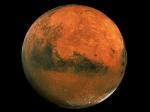
The Increased size of the Red Planet
During the early part of 2005 news stories have been floated around that Mars is a on a close approach towards Earth and may appear as a bright red object with only the Moon brighter. Why the repeat promotion of this event to the general public? If a large red object did appear, most would confuse it with Mars. This same event has already played out just two years before 2003 when passage of the 12th was expected, but took up an almost static position next to the Sun. If we research newspaper reports from 2003, this close-up event was noted and remember Mars did not appear large to the naked eye as most were lead to believe. The purpose of these announcements was to confuse the general public long enough to allow the elite safe passage to their bunkers as all would assume the bright red object, the 12th as Mars. The unknowing public would only suspect something was wrong only after the object grew in size and drew closer days later, at that time it is too late.
All Rights Reserved: Copyright 2005
News stories courtesy of CNN
| Planetary
approach is nearest in 60,000 years
By Richard
Stenger |
|
(CNN)
-- The last time the red planet was this close to Earth
60,100 years ago, man lived in caves.
No
wonder when Mars and Earth synchronized their orbits a few minutes before 6 a.m.
EDT Wednesday -- bringing them closer to each other than at any time in recorded
history -- thousands of people around the globe went outside to take a peek.
"Knowing that this is once in a lifetime that I can see another planet with
the naked eye, yeah, it's great," said Rebecca Horton, a stargazer from
Sydney, Australia. Astronomers say Mars, five times closer now than six months
ago, is about 34.6 million miles away, making it the brightest nighttime object
except the moon. It is possible to get some fairly close encounters every few
years," said amateur astronomer Paul Shallow. "It does come around,
but not this close." But with the far-away planet getting so close, some
hopeful watchers felt gypped by Mother Nature. In Oakland, California, where
hundreds of space fans paid $11 to attend the Chabot Space & Science
Center's "Mars Mania Costume Party," clouds rolled in along with night
sky Tuesday. Mars was fogged out, and there were no refunds. But the good news
is that Mars will remain a stunning nighttime attraction for weeks. Most sky
watchers can see the planet, presently in the constellation Aquarius, in the
southeastern sky soon after sunset, high overhead during the midnight hours and
in the southwestern sky before sunrise. Backyard telescopes may coax features
out of the reddish, orange blur, including dark, mottled streaks, which inspired
scientists of past centuries to envision intricate canals and advanced Martian
civilizations. The rare configuration of 2003 has stoked renewed, albeit not as
fanciful, interest in Mars, which on average cruises 50 million miles farther
from the sun than Earth does. About every 26 months, the two planets pass
relatively close to one another, during periods now known as opposition. What
makes this one noteworthy is that Mars, which follows an extremely elliptical or
egg-shaped path, is currently at it closest point to the sun during its orbit.
Those two conditions, along with a few obscure celestial variables, have
produced an astronomical chance of a lifetime, or several lifetimes actually.
Mars won't pass closer to Earth until 2287, according to astronomers.
Besides
awing the curious, the alignment has motivated numerous governments to dispatch
missions to the red planet. Taking advantage of the shorter trip distance, two
U.S. and two European probes set off earlier this year, all to arrive at the end
of the year. "Mars fever has caught, not only for amateur astronomers, who
are getting their best look at the planet ever and that we'll ever have in our
life, but also for professionals, as you know, with the [NASA] Mars Rovers and
other spacecraft that are en route," said David Eicher, editor of Astronomy
magazine.
http://www.cnn.com/2003/TECH/space/08/27/mars.closeup/index.html
CNN)
-- Like cogs and gears on a colossal
clock, Earth and Mars will soon synchronize their orbits, bringing them closer
to each other than anytime in recorded history.
The
alignment early Wednesday is expected to send droves of earthlings out of their
homes overnight to marvel at the glowing reddish point in the sky, for now the
brightest nighttime object except the moon.
Mars,
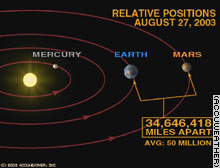
five times closer now than six months ago, will be 34.6 million miles away, its
closest brush with Earth in about 60,000 years, according to calculations by
international astronomers.
The
closest approach officially takes place minutes before 6 a.m. EDT. The nearest
terrestrial place to Mars at that time will be Tahiti, according to astronomers.
But just about anywhere with dark skies will be a good place for an observation
party.
"Mars
coming this close is an excellent opportunity for amateur astronomers to see
Mars," International Mars Society President Robert Zubrin said. "With
a good amateur telescope right now, you can easily see the ice cap on the
Martian pole."
Can't
make the Wednesday show? No problem. Mars will remain a stunning nighttime
attraction for weeks.
Most
sky watchers can see the planet, presently in the constellation Aquarius, in the
southeastern sky soon after sunset, high overhead during the midnight hours and
in the southwestern sky before sunrise.
Backyard
telescopes may coax features out of the reddish, orange blur, including the
legendary dark channels or "canals," which inspired scientists of past
centuries to predict advanced Martian civilizations.
The
rare configuration of 2003 has stoked renewed, albeit not as fanciful, interest
in Mars, which on average cruises 50 million miles farther from the sun than
Earth does.
About
every 26 months, the two planets pass relatively close to one another, during
periods now known as opposition.
What
makes this one noteworthy is that Mars, which follows an extremely elliptical or
egg-shaped path, is currently at it closest point to the sun during its orbit.
Those
two conditions, along with a few obscure celestial variables, have produced an
astronomical chance of a lifetime, or several lifetimes actually.
|
Mars and Earth will be separated by
34,646,418 million miles at 5:51 a.m. ET Wednesday. |
|
Mars
won't pass closer to Earth until 2287, according to astronomers.
Besides
awing the curious, the alignment has motivated numerous governments to dispatch
missions to the red planet.
Taking
advantage of the shorter trip distance, two U.S. and two European probes set off
earlier this year, all to arrive at the end of the year.
"Mars
fever has caught, not only for amateur astronomers, who are getting their best
look at the planet ever and that we'll ever have in our life, but also for
professionals, as you know, with the [NASA] Mars Rovers and other spacecraft
that are en route," said David Eicher, editor of Astronomy magazine.