The
Planetary Orbital Plane and Motion
The
Orbital Plane
The orbital plane, a relative narrow zone expanding outwards based on the Sun’s equator as its center line, contains all of the planets in this solar system. Currently, consensus proposes a theory that has our solar system's formation due to gravity condensing a gaseous cloud composed mostly of hydrogen gas nebula and other heavy elements into a accreting rotating disc, where the planets formed in the present day orbital plane at preconceived distances according to Bode’s Law. The larger gas planets were predicted to form on the outside of this solar system due to low thermal temperatures. There has been little progression in these theories so lets introduce an alternate, which will close many inconsistencies considered for an explanation of the formation of our solar system.
The orbital plane of a solar system is constantly maintained by the interaction of 2 distinct fields of repulsion and gravity sub atomic particles emanating and returning to the Sun. The primary subatomic particle flow is responsible for the returning gravitational field effect, generates repulsion streams, which exit the spherical surface of the Sun. There are many factors, which determine the features of the streams, but lets examine the most important for a simplistic model.
We must consider the interdependency between the 2 types of exiting repulsion streams, as the core builds and stores from the incoming gravitational subatomic particle flow entering the mass, the containment field deep within the center breaches at the weakest points along the equatorial rotational plane. Due to rotational torque the initial streams are emitted along the equator of the Sun as it overcomes the incoming gravity particle field and bursts outward with the added centrifugal force away from the core. Ejection is along the ecliptic plane as 8 equidistant streams focused with the moment of torque inherited from the Sun's rotation. As pressure builds again, the repulsion subatomic particle stream bursts are released from the various weak points about the total area of the spherical core containment shell as vacuum left by the preceding flow along the equator back fills. The shifting between the 2 particles streams is the refresh rate of the gravitational flow emanating from the core or the frequency of the gravitational field, a key determinate for field intensity.
The primary difference between the streams is not where originate, but their density. The 8 concentrated streams spread about the equatorial plane as opposed a more diffused set of streams about the globe with lower pressures due to greater number of points of ejection. The higher density repulsion particles type 2 are released in concentrated spurts along the Sun’s equator. We will now examine the particle flow away from and towards the Sun first and then consider the rotational torque on the exiting repulsion subatomic particles along the orbital plane.
Establishing the base gravitational field surrounding the Sun, which is emitted 360 degrees about each of the x, y, z axis from the stellar mass's internal spherical core by a set of somewhat equidistant low density repulsion streams. Expansion away from the Sun and the back pressure from the interstellar medium dark matter reaches a point of equilibrium and the flow of repulsion subatomic particles has expanded and stagnates, a slow draft organizes and reverses the subatomic particle flow back towards the Sun as gravity particles. Gravitational field dynamics allow for a dense repulsion stream to cut through along the ecliptic plane. Instead of the interstellar medium, the pressure build up responsible for containment perpendicular to the direction movement during expansion above and below the ecliptic plane is against the low density gravitational field. This exponential expansion of the repulsion sub atomic particle flow is in a direction relationship to the containment force of the low density gravity field, in which density decreases as a function of distance.
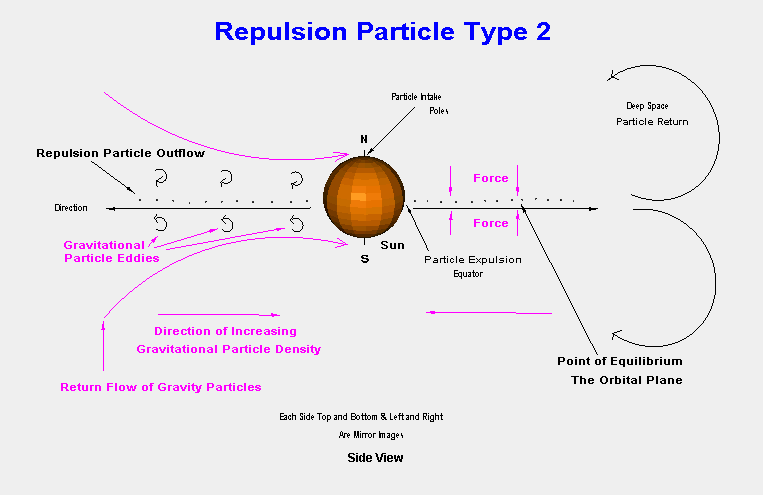
It is the return flow that affect or maintains the positions of the planets within the solar system or any other object close to the ecliptic plane. Sandwiched between the 2 high density return flows and the originating repulsion high density streams contained within the outgoing flow along the ecliptic, the interaction between the internal high density streams creates turbulent eddies curling towards the ecliptic. As the distance closes towards the Sun the return flow is compressed from above and below towards the ecliptic as the density of the primary spherical gravitational field also increases 8 fold per unit of distance being reduced by half. Current theories use the unit 4, why the discrepancy? Where a sphere is the source only the side facing the movement is part of the equation, thus half of 8.
What is the cause of these eddies created along the return flow of the high density repulsion subatomic particles diverted towards the ecliptic while approaching the Sun? You have been introduced to the two repulsion streams and the refresh frequency, which is responsible for gravitational field intensity within a mass. Normally the high density repulsion streams exiting along the ecliptic and its sandwiched return flow to either side of the outgoing stream would produce natural eddies as the 2 streams interact while moving in opposing directions, eddies would be a reaction to interaction along the edges. A careful examination reveals circular motion gravitational subatomic particles applies a overall net force applied to a mass within the ecliptic between the outgoing and return flow, approaches an equilibrium or maintains static relationship, thus not affecting the position or present motion of the object. So what does occur during the interaction of both flows?
The key that changes this relationship between the outgoing and incoming streams is related gravitational field frequency emanating from the Sun's core. It is the gaps amid the repulsion bursts along the ecliptic that produces a low density draft. This differential attracts the high density gravity particles flowing towards the Sun to seek equilibrium by flowing towards and into the low density fields between the outgoing bursts, thus filling the gaps. During this process there is a force directed through the motion the subatomic particles directed towards the ecliptic plane as they pass through a planetary mass or object, but does not overshoot the neutral plane as the gravity particles. Now caught within the flow, they are drawn away as part of the outgoing stream. It is this relationship that maintains the planets within the ecliptic plane and forces a planet back into the plane if temporarily affected by an outside force. As the distance to the Sun closes the overall low density field to the outside of both streams increases in concentration, thus compression. The gravitational force towards the ecliptic intensifies as a function of distance to the Sun or the ability for an object to move above or below the ecliptic becomes more difficult the closer it is to the Sun. This is the principle of how the orbital plane functions and is the basis for planetary ring formation.
As the once dense repulsion streams return flowing just to the outside of the emitted streams along the ecliptic approaches the surface of the Sun, it is now diffused after the massive bleed off of sub atomic particles pulled away into the draft gaps between the repulsion subatomic particle bursts along the equatorial plane of our Sun. Any additional flow near the equator is cancelled by the opposing centrifugal force acting against gravitational attraction, the system achieves equilibrium with the rest of the gravitational flow entering the surface of the solar mass.
Details on Repulsion Sub Atomic Particle Density Type 2 Flow
Here scientists will grasp a basic view of the particle flow from its expulsion point along the equator of the Sun to its return about its surface.
|
Diagram 1
|
Planetary
Motion
There is speculation regarding the orbital motion of the planets and how it is achieved. Scientists state planetary motion was initiated at the dawn of this solar system, as the accretion disk of gas and matter related to the formation of solar systems condenses about a static solar mass. As the radii of the cloud decreases conservation motion translates into rotation of all objects within the affected field. Lets reference a document describing mankind's theories on the origin of planetary motion.
Newton once stated, that an object in motion stays in motion, unless it is acted upon an outside force. In the case of the planets, all achieved an orbital velocity around the Sun and maintained orbital stability. The contradiction is that the all objects would have to collapse uniformly and the mass accreted would be interdependent to the surrounding distance, orbital velocity decreasing in relation to mass gained, yet maintain an orbital path that is not altered by the collision adding the mass, all to sustain order about the various planetary masses in relation the primary variable, the Sun's mass. Have any of you considered these factors when you formulated or supported your theories, anyone?
Gravity, which emanates from the Sun, is that outside force in relation to the orbiting planets. Changing what would be a straight tangential path of the planets to always point 90 degrees away from a pre determined radius of the Sun into an elliptical path due to outside gravitational influences. According to the present day laws of motion, when a force is applied to an object that changes its direction from straight motion to one that is curved, forward momentum slows on the affected object, causing erosion of the orbital path, thus plunging into the gravitational giant of this solar system, the Sun. Astronomers never considered that the mass of the Sun slowly eroding over time due to fusion energy conversion and subatomic particle expulsion, due to the solar wind. This leads to the solar mass problem, which would eventually allow the planets fly off into space as the holding force of the Sun's gravity diminishes over time. So what propels the planet’s constant orbits?
Inside our Sun’s core, movement of matter is initiated by pressure and gravitational inequalities trying to find equilibrium due to attractive or repulsive forces in the galaxy. The motion becomes circular as pockets of mass are attracted within the core to an relative point of equilibrium within the the 3 dimensional grid representing the core, but momentum in this or any fluid core is maintained. The resultant is that the pocket mass related to the affected motion overshoots and returns a point where the attraction takes hold again with each passing repetition, the initiated motion reinforces the previous motion, spin develops. This is the essence of how movement in the core of the Sun is maintained. It is the frictional contact of this core with the outer layers of the Sun’s mass, that drives the observed rotation of the Sun and transfers the rotational torque to subatomic particle repulsion streams emitted.
Planetary motion is a byproduct of repulsion subatomic particle flow out of the Sun’s mass and its rotation. You are now familiar of how the repulsion sub atomic particle created and flows outward from the Sun, now lets cover the affects of rotational torque on the repulsion particle stream and how this affects objects within our solar system.
When the repulsion particles are expelled off the equator, they have angular momentum inherited from the Sun’s rotation. These particles maintain the distance of the planetary orbits at equilibrium point between the Sun and all inner and outer objects. This point is where the repulsion force and centrifugal force, due to rotational velocity of the Sun's containment core, the outward average repulsion stream emitted from inner planets and a lesser extent average inward pressure from the outer planets equals total gravitational attraction force. The repulsion subatomic particle streams expand away from the Sun in a curved pin-wheeled motion, which the rotational torque on these particles provides a lateral force along the ecliptic plane as the particles pass through planetary masses. It is this push that sustains the forward momentum of the planets and other objects within the solar system. This is why the planets move in the same direction with orbital speeds related to their distance from the Sun. Evidence of this motion can be seen in a system of many cosmic objects, as the gather in numbers preceding the wake of repulsion particles extending out in a curved arm from the gravitational center. An example would be M-51, the Whirlpool Galaxy. There is no chance occurrence here.
Details on the 8 Repulsion Particle Streams
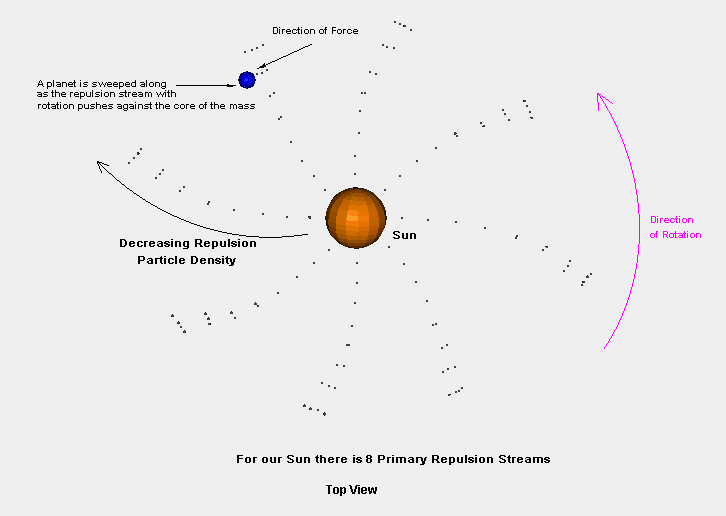 |
Diagram 2
|
So how would the theory explain the 5 degree plane of the Moon off ecliptic?
The primary voice the orbital plane of the Moon is listening to is the Sun, but there is a secondary voice. The Earth also has its own repulsion stream, which maintains the moon's orbital velocity. Due the close proximity of the Moon to the Earth, the particle flow tries to initiate a neutral zone at its equatorial plane, 23.5 degrees, but it is compromised by the Sun's particle flow. It is the interaction of the 2 particle flows that produces the compromise of approximately 5 degrees off ecliptic the neutral point between the 2 repulsion subatomic particle flows.
All Rights Reserved: © Copyright 2000, 2002, 2004, 2009