Extra
Solar Planets
Short
Summary
Original
Version for Printing
|
The discovery of extra solar planets
revolving around distant stars has been a great achievement for mankind and his
quest to unlock the secrets of the universe. Their appearance has opened up the
possibility of life existing outside of our own solar system among the many
stars. On the other hand the extra solar planets with their documented
approximations of mass, orbital speed, and distances from host stars have
exposed the many flaws in present day astrophysics and how astronomers predicted
the formation of planets. |
|
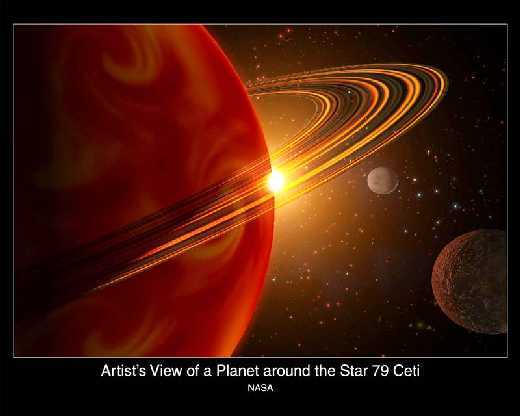 |
Many
Jupiter sized planets have been
found revolving in close proximity of stars at various rates of orbital
velocities.
One example would be the planet orbiting the sun-like G
class star HD 38529 located approximately 138 light years from Earth. The
planet’s mass orbital period and distance from the host star respectively is a
minimum of .77 of Jupiter’s mass, an orbital period of 14.31 Earth days, and
an average distance from the star is .129 AU (Astronomical Units) or 12 million
miles. But how can this planetary stellar discovery hold up, if the foundation
of planetary formation established in the circles of elite astrophysicists
dictates, that any mass similar to Jupiter has to be a hydrogen based gas
planet.
Planetary formation according to present accepted theories would have
cosmic objects similar in mass and size of the gas planets Jupiter, Saturn,
Uranus, and Neptune coalescing on the outer edges of a contracting gaseous disk
of a proto solar system where solid available hydrogen and NH molecules precipitates around a cold rocky
mass attracted by a strong gravitational field. What force would be the cause of a planet in an outer orbit to move to an
interior position, since the gas giants develop far away from the heat of the
solar mass and the need for available H and NH molecule clouds? The answer would be the strongest gravitational present in
the local area or the host star.
Any star capable of changing an orbit of a
planet by gravitational attraction, would also capture it and assimilate it on
impact with the solar mass. An outside gravitational force upon a planet’s
capture cannot alter motion, once directed towards a stellar object. The result
of this encounter is assimilation by the solar mass after impact. An orbital
path is maintained by other factors such as the
repulsion
force still mostly unknown to current astrophysics. This
force builds between a planet and the host primary star slowly. The point where the repulsion
force, an outward force emanating from the star, equalizes the force of gravity,
which draws the planet in is where the path of orbit is established. The planet’s angle of
approach and velocity determines the original eccentricity of the orbit, but
does revert to more circular orbit over time unless affected by gravity from
another star in close proximity or as part of a multiple stellar system. The
rotational velocity of the
planets’ orbit is maintained by the angular momentum of the repulsion
particle stream at the point of intersection of the planet’s orbital distance from
the star. Then there is the obvious, planetary absorption of solar heat upon
approach. How long would solid or liquid hydrogen gas based planet last in an
orbit that would be similar to 1/3 the distance from our Sun to our planet
Mercury? The result would be hydrogen and other light gases boiling off the
surface of the planet and stripped away by the solar wind of the star exposing the heavy elements of what was the core of the
planet.
Many scientists will realize the fact that the gravity emanating
from this object would not hold hydrogen in its gaseous form, as that of the gas
planets in this solar system which attracted hydrogen in its solid form. Surrounded by gaseous hydrogen heated to extremes
under the conditions of an inner
orbit, could not provide a
sufficient gravitational containment force. The pressure differentials would
cause surface materials related to a gas planet to evaporate and escape into the low-pressure
environment of outer space as a decreasing volume displacement causing a push back from
the press of
Dark Matter containment is not enough for
an excited heated light hydrogen atmosphere.
Other factors were overlooked, a
material for a rocky core would not be in great supply for a natural planetary formation
to occur so close to the assimilation process of a forming stellar mass. In essence, there could not be a planetary mass fitting the parameters
established by Earth’s science to explain what mankind has discovered. Leaving
only a planetary mass similar to a terrestrial planet, which according to mankind’s
theory of the formation of planets does not exist in a mass similar to a gas
planet. It is time to reexamine the theories pertaining to the formation of
planetary objects within a solar system where mass is a determinate of a gas or
terrestrial planet.
All Rights
Reserved: © Copyright 2000, 2009