Stellar and Planetary
Formation & Orbital Spacing
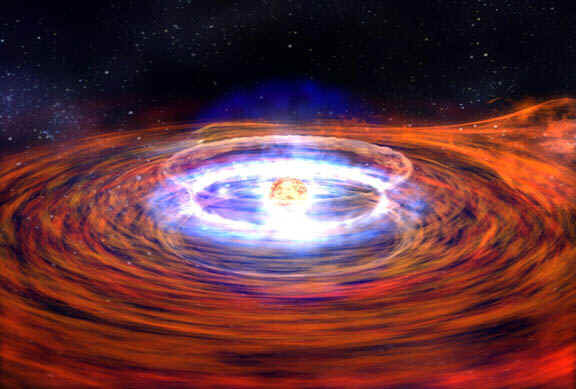
Mankind has long pondered theories on the creation of planetary systems and the spacing of the orbits around solar masses. The most accepted theory has planets coalescing out of a flat disk of gas and matter debris that rotates around new forming stars. According to Bode’s Laws, rings of gas and matter gather at specific distances in these disks from the solar mass, these points are where the planets will try and form. All of which is inaccurate.
|
Mankind's Sequence of Events for Planetary Formation |
| Creation from a whirling spinning gaseous nebula with a star forming at its center | |
| Phase 1 |
| Rings coalesce from gaseous matter, the predecessors of planets | 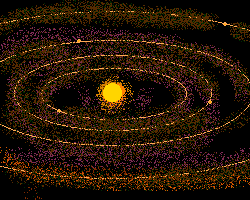 |
|
Phase 2 |
What Aspects will be Covered
Planetary Formation
What is Responsible for the Various forms of Atmospheres
How are the Moons Created and Captured by Planets
Oscillation of the Orbital Paths of Asteroids
Stellar Creation
Variable Stars
What mankind does not know is that stars and planets start out indistinguishable in their formation. it is about relative mass. All cosmic objects immediately coalesce after the local big bang and incubate in the dense hydrogen nebula clouds expanding out of the big bang. Heavy elements gather and merge creating an ever growing mass around the dominant mass depleting the hydrogen cloud within many millions of miles. This process is accelerated exponentially by gravity particles flowing towards the new mass gathering new matter. Continuing until, all available heavy elements and light gases have been assimilated by dominant cosmic object, which are of varied size and composition.
Examining a detailed growth cycle and its many variations of a cosmic stellar object, I will set the time clock to shortly before a localized Big Bang will occur. In this random sector of the universe, a black hole of galactic proportions has cannibalized all matter and stores most of the energy within the local galactic area. Scientist have documented the existence of black holes at the centers of galaxies, but still have yet to discover the link related to the birth and collapse of a galaxy or cluster. A mature black hole after assimilating all matter within area expels energy about it poles of rotation over time collapses under its own mass, thus initiating a gravitational force that constricts molecular movement in the core. Pressures immediately build as particle pressure overload the core past the black hole’s gravitational containment field and it explodes releasing all mass into a localized Big Bang. Dispersing matter and energy in a 360-degree spherical random pattern of clumping, even dispersal and voids, reseeding what was once an space filled with a scarce field of subatomic particles related to dark matter. A renewed mix of elements and molecules now expands from the point of origin. The heavy elements due to their mass, starts the gravitational spherical coalescing process. First, objects on the edge of expansion release their heat into space, compression starts away from the center point of initialization. This inequality is responsible for rotation of the object. Wobble starts due to the lop sided compression of mass, but as rotation increases spin about the axis stabilizes for formation of cosmic objects.
All cosmic objects are drifting aimlessly or locked in a mutual gravitational attraction between cosmic masses pivoting around an imaginary center of the masses for all objects in various stages of development in the dense gaseous clouds. Shortly after a localize Big Bang has occurred in that area of the Universe. It is only the gravitational force of the solar masses that captures the immature cosmic objects, planets and debris that initiates a planetary system. The disks of debris rotating around solar mass, already has formed planets contained within them. They are not responsible for creation of planets, but they do add mass to the captured planets when sharing the same orbit. The planets also in turn capture moons and if of a sufficient mass maintain fields of small debris in the shape of rings. Most star systems are binary at a minimum. So how would these disks of planetary matter develop planets in multiple stellar gravitational fields? A conflicting process of planet building would occur under established theories, disturbing the current views of scientists.
Bode’s Law does not predict orbital spacing as mankind assumes. In some systems duel planets reside in the same orbit always hidden on the other side of the solar object. Orbital spacing is reliant upon equilibrium of the gravitational and repulsion forces generated between cosmic bodies in the area. Lets examine our solar system for an example. If the mass of the Sun would increase substantially, the orbits of the planets present would shift inward due to the increased gravitational force before the repulsion force would invoke to maintain their orbits. A more applicable example would be to interchange the orbits of Jupiter and Venus, and see how this would affect the spacing of the planets. Jupiter would ride in an orbit larger than Venus present position. Mercury’s orbit around the Sun would shrink due to the large repulsion force pushing inward from Jupiter. The planets beyond Jupiter starting with Earth would fan out into new positions. Of course this scenario would be short lived, because Jupiter’s light elements would boil off and escape into space leaving only its rocky core, thus another terrestrial planet would have developed.
Formation of Planets and their Atmospheres
In this explanation of planetary formation in our solar system, it does follow the same formation process in other systems with similar size and stellar types coalescing within clouds of matter containing the same general mix of compounds and gases.
Our Sun started first as a rocky core permeated with hydrogen. It was the gravitational force from this mass that assimilates most of the hydrogen within the inner solar system. So how does this dictate what properties the inner planets would adapt? First condition no matter of a large mass or small it would of a rock type, atmosphere would consist mainly of CO2 if the mass was sufficient enough to hold it as a function of volume displaced and strength of the planetary gravitational field also taking into condition the stripping effect of an intense solar wind due to the close orbital paths near the Sun. The atmosphere favors carbon dioxide due to the NH molecule and hydrogen drain from the interstellar medium by the Sun's gravitational absorption within the inner orbits. As the oxides are released out the molten surface rock it combines with available carbon near the surface thus the heavy gas is easily held by moderate gravitational fields where strong solar winds are present.
Exploring our inner planets, Mercury's mass was insufficient to hold an atmosphere, so as it was created and held near the surface was stripped away and dissipated into space. Venus further away had enough mass coupled with a decreased solar wind, allowing the CO2 atmosphere to prevailed with only a slight availability of H-He and more of the heavier NH molecules. The hot surface coupled with volcanic activity allowed carbon and sulfur to combine with the leaching oxygen escaping from the surface primarily instead of captured NH molecules. So what little oxygen, which combined with the H component of the NH molecule accounts for the water vapor created. The released nitrogen builds into the atmosphere and the water created combines with the sulfur dioxide yielding sulfuric acid and some pure water vapor. We are skipping Earth, which will be covered as we address the asteroid belt. Moving to Mars, its orbital position during formation is now far enough the there are some available hydrogen and NH molecules to interact during atmospheric formation. Mars which had a weak magnetic field offered some electrical atmospheric disturbances during the leaching of oxides to provide oxygen. Although the vast majority oxygen released from the surface created the carbon dioxide atmosphere, but where hydrogen, oxygen and lightning occurred, water rained down upon the surface cooling it accelerating more water creation within the limited area, thus carbon dioxide production impeded. Mars also has another factor involving the creation of water, it is far enough away from the Sun where an average surface temperature below the boiling point of water, which is essential. The creation of a water planet is more complex, as the forming planetary mass must have the properties of a availability of strong magnetic field coupled with rotation to create surface turmoil and a point where the Sun's heat maintains the water in a cool liquid or frozen form and the availability hydrogen, NH molecules, and inert gases helium & argon which can be captured by the gravitational field. This was the conditions that existed in the zone of the asteroid belt where various water planets were created. Now all except Earth were captured as moons or collided with only comets as remnants of their past existence.
So how did this process create the water and its atmosphere presently known to Earth? As the NH molecule was captured at a more accelerated rate due to gravitational attraction rather than the simple H-He atoms thus when the proto Earth developed that resulted as the present day Earth. With the iron-nickel core formed, its magnetic field coupled with rotational turmoil, the oxygen leaching from the surface, it first combined with carbon in the extreme heat. As violent lightning occurred about the surface in the thin proto carbon dioxide atmosphere, the NH molecules broke down. The oxygen combined with the hydrogen raining water upon the surface releasing free nitrogen. This limited carbon dioxide to a small percentage, yet allowed nitrogen to become the major atmospheric component. As the atmosphere builds, oxygen and hydrogen continued to rain down thus the runoff contained large quantities of dissolved minerals and land based salts creating the salt oceans. The heavier atmosphere components of carbon dioxide, nitrogen, and oxygen displaces hydrogen, argon, helium and other trace gases towards the outer edges other atmospheric envelope where only small percentages are left after escaping the low gravitational field at extreme heights above Earth's surface. As a consequence, only the NH molecules with electrical disturbances creating water at a decreasing rate. Most of the oxygen in the latter phases is being dissolved within the oceans and it is this that maintains the nitrogen-oxygen balance. It is only that the Earth prototype was hit, that change it from the water planets that once residing the asteroid belt, now frozen moons captured by Jupiter's gravity. The Earth when hit was displaced to its present orbit with a lost of the majority of its mass and water creating the dry continents as the oceans pooled in the new Pacific basin.
As we move to the outer planets the rocky cores had little time to create carbon dioxide due rapid cooling of the surface due to distance from the Sun. The hydrogen and helium interstellar gas content is very dense as the area which was captured by the Sun has been exceeded. The NH molecules are present, but not as abundant as hydrogen both in a solid form are easily attracted by strong gravitational forces. The rocky cores have a little water creation in the absence a strong magnetic field creating electrical turbulence in the atmosphere. So the acquired NH molecules under compression combines with free hydrogen atoms creating layers of frozen hydrogen, helium, ammonia and methane. This is the condition that consistent of planetary formation for the outermost planets. What about Pluto and how does it fit in or is its recent status omitted justified? It doesn't and the answer is yes.
So how do continental plates form on a water planet? As electrical disturbances on a planet occur it is within a particular zone of activity, where oxygen has leached from the surface material and bonds with either hydrogen or the NH molecules, water forms. It immediately evaporates approaching the heated surface of the planet, creating updrafts and atmospheric turmoil. It isn't until sufficient water is created that evaporation is overwhelmed by condensation and precipitation hits and cools the surface of the planet outer molten surface. It rapidly cools and solidifies the weight of the solid crust sinks creating a natural depression side build, the water pools and forces down the solidified crust. As it sinks the edges build deepening the accumulated pools of water become ocean basins filled with dissolved mineral and salts washing down from the surface. As the depth becomes what is measured in kilometers there is a push up or popping of crust in an opposing area compensating in direct proportion to the depression. The crust builds as it push upwards while the seafloor stabilizes, this is why the seafloor crust is thinner than land.
How are the Moons Created and Captured by Planets
The moons of a solar system, where and how were formed, more importantly what is the process of planetary capture? Within any planetary system where mass assimilates in its natural form, it is spherical. Shapes of cosmic objects that on the majority that vary from this formation tend to be a result of a collision. As a mass assimilates matter it is dependent upon available material and dust within the area. Contrary to current belief multiple objects of various sizes do develop within any orbital band perceived by mankind. In many instances several masses reached a point where the assimilation process progresses at many points rather than one dominant planetary mass. In our solar system all of dust and debris in all fields of rotation coalesce, the exception the asteroid belt, which is addressed in the capture theory. Over time the repulsion force streaming out of our Sun, which drives orbital velocity as a function of mass coupled with pressure voids that impedes or accelerates a mass using the same general orbital path needs to be considered. Overall only if similar masses occupy the same orbital band where pressure voids tends to separate planets sharing the same orbit does a rare dual binary orbit develops on opposing sides of the star. If you allow 2 pin balls of equal size and mass and both are introduced to the same circular path the eventually separate on opposite ends, do you think this does not happen in the universe? When there are various objects where the mass is unequal sharing the same orbital band, which is the primary occurrence in the universe, the repulsion force emanating from the solar mass, in our system the Sun, this force eventually sweeps the smaller objects towards the dominate gravitational object. Once the addition becomes part of the gravitational field affects occur, eccentricity of all moons already in planetary rotation result from the push in of the new object and the oscillation that follows, compression of the field, a relative increase of orbital velocity which the smaller objects that were not captured by the Sun now become moons of the dominant planet gravitational field. Orbits and eccentricity is determined by a compromise of entry velocity, distance from the planet and the compromise of gravity and repulsion forces first between the held object and the newly acquired moon and adjustments due to other moons already in place. Was our Moon a product of this process? No, our Moon was captured as a result of a collision within the asteroid belt, details covered in the Capture Theory.
Stellar Creation
From the inception of its creation, the stellar rocky core, the starting essence of the cosmic object that achieves stellar radiance has four main qualities to its development. The qualities are its permeation of hydrogen core anomalies to heavy elements, whether those core anomalies are homogeneous in size and density, the final size, and density of the rocky core when developing shortly after the big bang.
It is the permeation ratio of hydrogen to heavy elements and the ratio of the volume of the core where fusion occurs to the total mass of the star in this development phase that determines the future potential of a cosmic object. A high ratio would be a prerequisite for fusion reactions going from blue stellar objects moving towards a lower level for red stars to a final the fusion reaction is an occasional sputter to completely shunted where the star does not light.
The rocky cores developing due to the forces of gravity in a dense hydrogen primordial nebula would have it mass permeated with dense hydrogen gas the closer it formed to time T= 0. Visualizing this process, lets look at a cubic unit of a rocky mass potential from T= 0, the inception of the big bang as it expands outward as time progresses. In this first phase of development, hydrogen is trapped in the cores of heavy elements in varying degrees of concentrations and sizes because equilibrium has not been achieved as matter continues to expands and density of light elements like hydrogen and helium drops once released from the gravitational compression of the black hole. The ratio of hydrogen gas infused into heavy elements mixing in the core decreases over time in a cosmic mass. As the density heavy matter decreases in relation to the expansion of its volume the light element are sucked into the matter. Now trapped, the loss of heat reverses the expansion to now compression and the proto stellar core has formed. This ratio of hydrogen gas to the other heavy elements in the core and its size in relation to the total mass is a key factor in determining potential for a cosmic mass to light. A star will not light if the heavy elements due to varying concentrations placement about the core dampens the fusion process from initiating or the process sputters at a low level as the stellar mass would absorb all internal energy before it reaches the surface where it radiates energy. The failed star would only be detectable by presence of its gravitational affects on objects within the area.
Rarely the rocky core grows quickly in an area that is rich in heavy elements with a mix light elements, but the latter stages of growth for the cosmic object is in an area depleted of hydrogen nebula. Resulting in a terrestrial planet growing to a size like similar to the planet Uranus. The seed core during the initial coalescing trapped sufficient hydrogen fuel in proportion to the heavy elements, compressed by gravity of the cosmic mass, ignites and proceeds at a slow controlled burn. Creating an object that releases heat and sometimes-diffused light, it is what mankind refers to as a Brown Dwarf. On the extreme end when massive fragments heavy elements, ejected from explosion coalesce first in very rich, dense, light element medium. The cores have accelerated their growth due to the abundance of heavy elements within gravitational reach of the initial core, gives rise to the large massive solar objects, the Giants.
On occasion, the anomalies in the size and concentration pockets of light elements permeating the core give rise to an uneven flow of fusion production. Rate of fusion accelerates the core expands countering gravitational compression pressure or core density needed to maintain fusion reactions subsides the core cycles from expansion to contraction and the fusion increases again in reaction and the cycle repeats, thus the variable star. This constant contraction and expansion of the core cascades events into further turmoil, as the star brightens and ebbs according to an availability of an unpredictable energy source and core compression.
All Rights Reserved: © Copyright 2000, 2009
Mankind's Theory on Planetary Formation