Gravitational Stellar Wobble
The
gravitational effects on stars or wobble that is now being detected by
astronomical observations have become the primary tool for identifying potential
planetary systems, trying to answer that age old question, is our solar system
unique and are we alone?
The
stellar Doppler shifts in
stellar
spectrum light observed, is a compromised path of final motion resulting from
combined complex interactions between gravity, repulsion, magnetic and other
subatomic particle flows yet to be discovered by mankind emanating from many cosmic
objects that transverse all parallel universes that cause an affect on the
stellar object. Although mankind assumes the primary gravitational tugs affecting a
stellar object is from a single attractive source, a planet within close proximity of the
star. But what force would account for a massive object based on planetary
models developed on Earth suggesting a hydrogen based planet due to its mass, which could not exist within the
close proximity of the heat signature emitted from the host star?
Current theories on gravitational stellar wobble would invalidate the planetary
theories involving gas giants. How would a planet coalesce so close to a star,
attain a substantial mass and revolve about the central solar mass in a matter of a few
days? Does this concept present a logical explanation of planetary movement or
is this just another contradiction in your theories? Lets review your laws of
centrifugal motion and the formation of a collapsing planetary-solar accretion disk.
When your concept of planetary formation, which involves coalescing of matter, a
gravitational host with enough mass to maintain capture of a rapidly revolving
object. Did you really think the your theory of planetary formation through
completely? As a star collapses and its mass establishes a gravitational
field in relation to mass vs. volume. As it shrinks its moment of rotational
pivot about its axis increases, but this rotational torque translates little of its rotation force
from
the star to the accretion disk surrounding the star as gravity decrease as a
function of distance. So according to mankind's
theories solar system should not exist, but be captured as the star's
gravitational field increases as a function reduction of the radius of mass.
We will address 2 common points
related to stellar wobble, first, unlit or visible stars in a multi stellar
system. Stellar wobble detected by the Doppler effect assumes one side of the
equation acceleration towards the planet as it revolves. Your laws of motion
states an object in motion stays in motion unless acted upon by an outside
force. So this planet causes a movement towards it, but its orbit is balanced by
orbital velocity and a specific distance from the stellar gravitational source. Stellar wobble theories never consider
the F = Ma to reverse the motion closing the distance between the planet and
star on the opposite side of the predicted planetary orbit. You have assumed the
planet's orbit was not affected and follows the same path to attract the star
back. How, your gravitational formulas are based on distance as the masses in
the original equation do not change enough to affect the orbital relationship, which has decreased
on one side and magically attracted on the other to maintain its original
orbital radii position. With
less force, due to a shift away from the original position, how do you reverse momentum, you don't. If you accelerate a star
towards a planet the orbit degrades and eventually the planet is assimilated,
there is no counter motion.
Stellar wobble is the
process of a star finding an equilibrium between similar massive objects especially in
multi stellar systems. There is a bounce about a static point as this process,
between the force of gravity and repulsion resolves itself. It is this movement
that the Doppler spectrum measurements of starlight are detecting. Yes, most stars have planets, and
many more than humans can imagine. A certain percentage has life in various forms of development. We
are not along or are in danger from benevolent alien life forms as some media
outlets and past administration government sponsored sites still in operation
with advanced funds would lead you to believe. The ability to
move about the universe, control time, transport matter, move planets, read your
mind, control that which we call nature, with all this power what has stopped them in the past or now?
When presented with an opinion, do not believe it because of a name, examine the
content and judge it by what you see, sense and experience. This is about to end and will change. This is the
process of life, through distress and turmoil the population moves or is forced towards a
tipping point where the ultimate decision is determined by a set of common experiences.
Addressing the second
point, the dip in light intensity as a predicted
planet passes in front.
Light
diffuses and can be inhibited within a close proximity, but you were taught by
Einstein that gravity bends the path of light. Do you not think over the vast
reaches of space, the light blocked by a planet over time and distance
differentials in sub atomic particle flow due to pressure voids would
bend light into the gap? Particle movement shows
when over a distance a void is quickly filled due to a natural process of
equalization. There are many factors involved
in the fusion process of a star, primarily a subdued pulsing of its intensity
due to a phased process occurring within the stellar core. But, the largest
point you never considered are Sun Spots, they rotate across the visible surface
and cannot be differentiated from a passing planet with current technology.
Astrophysicists
presented exciting news to the world of discoveries only to come up with a
planetary orbital model that contradicts all logic related to current theories
of mankind. How can a Jupiter
sized planet, under current consensus be composed primarily of light frozen
elements of hydrogen and helium according to present day astronomical
theories revolve in close proximity around a star in a matter of days? Any Jupiter type planetary
mass
exhibiting the orbital and thermal heat absorption dynamics of Mercury would vaporize
all light elements down to
its gravitational attractant rocky core.
The introduction of extreme solar
heat would create a
loss of gravitational force as accretion of the mass attracts only stable solid
mass as all light elements quickly dissipates. Its atmosphere would
precipitate into the universe due to its velocity and atmospheric pressure
variances between the hot core and the vacuum of outer space while revolving
around the star. Thus, almost all solar planets presently considered "found", could not exist under the
contradictory rules of mankind’s
science.
Doubts lets examine the current technology associated with gravitational
wobble.
|
What's Wrong with this
Diagram? If we
were to designate the position of the unseen planet in the upper diagram
to the right
at 90 degrees along the circular path, how would a gravitational between
the 2 objects create a force 90 degrees away from the line of force
between both objects? It wouldn't, the attraction for the blue shifted
light would occur with the planet at 180 degrees position along the path as the
planet and star shifted towards each other in order to create the
shorten wave length of light emitted from the stellar source. This shift
towards each other does not occur at specific points as one would be led
to believe, but according to mankind's gravitational formulas, happens
along the entire orbital path. The result, really would a planet
spiraling inward towards the stellar gravitational source due to the
attraction while orbital velocity the counter could not compensate for
the shifting new force in what seems a balanced equation. |
|
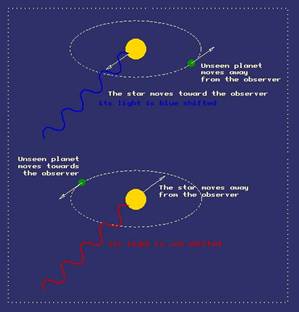 |
Image courtesy of :
http://astronomyonline.org/images/ImagesFromPapers/Wobble.jpg
All
Rights Reserved: © Copyright 2002, 2010
Related
Articles:
Extra
Solar Planets
Return
to Main Menu
Return
to Title Page1