Jupiter’s
Red Spot
and Bands
Original
Version for Print
|
Mankind has long pondered
the source of the Red Spot anomaly on the surface of Jupiter since its
discovery by the first telescopes. Current theories in planetary
astronomy has proposed this hypothesis; where a centuries old
atmospheric disturbance has continued to rotate in a somewhat static
position affecting the surface, similar to the hurricanes and typhoons
occurring on Earth, as the cause. Yet in the midst of the many bands of
high-speed wind currents racing horizontally in varying latitudes along
the surface of Jupiter, the Red Spot has maintained its position, size,
and form over the last several centuries. The red hue and cyclonic flow,
unusual properties of the Red Spot does not seem to fit any pattern observed on
the other known planets, but a secondary site, though smaller exhibits the same
properties. Therefore, one must look carefully at the total planetary processes
occurring not only in its atmosphere, but also consider the subsurface and core,
to find the cause to this mystery.
|
|
|
T
The principles that
occur within the planetary core and its anomalies that carry these disturbances
to the surface of Jupiter is
similar to that of a small star. Reviewing the advent of stellar and planetary
creation in this galactic sector of the universe, lets examine a brief sequence
of events. The local Big
Bang initialized the expansion of matter and energy from a massive black
hole that swallowed all mass within its gravitational pull where absorption
reached galactic proportions. The expansion of the local
area immediately was dampened due to loss of heat subatomic particles, thus
molecular compression and gravity initiates the formation of mass that clumps
within the interstellar
medium. At the center of the localized big bang, the affected
environment leaves a remnant mass and a black hole is reinitiated or slowly
evolves over creating a new dominate gravitational source that holds and
provides rotation for the newly formed galaxy.
Matter left over from the
formation of stellar objects coalesced into ever-growing planetary masses among
the gaseous nebula cloud and solidify until gravity and
repulsion forces
organized rotation about a central point, the primary stellar object. So what
processes does a stellar object or in this case our Sun and the planet Jupiter
have in common?
The heavy elements, which makes
up most of the coalescing matter during the initial stages, quickly grows, due
to gravitational forces, trapping hydrogen gas and other light elements
indiscriminately within its structure, permeating what is to become the cosmic
object’s core. In Jupiter’s case, its planetary formation was dependant on the
heavy elements, once in abundance in the neighborhood during the early stages of
development of Jupiter, now are in short supply in the local spatial area. The
planet’s rate of
formation and size relied on the strength of the gravitational force
emanating from the future rocky core of Jupiter, and the continuing availability
of light elements, which is at a higher density than the area depleted by the
Sun containing the inner planets spread about the local spatial area. Jupiter’s
core, now sufficiently massive to attract the light elements from its
gravitational field, begins to grow. The process continues, until all the
available hydrogen nebula matter in the proto solar system is so sparse gravity
can no longer gather enough light elements to offset its losses escaping back
into space for a positive expansion, thus planetary growth terminates.
Jupiter’s
mass is now sufficiently large enough, that gravitational compression can
initiate random sporadic internal fusion reactions and does, but differentiates
itself from a star by its composition and the amount of energy produced its
core. In a star, hydrogen pockets are
distributed in a frequency, that when fusion reactions start due to compression, the energy,
heat and
light produced exceeds the caring capacity of the stellar mass. Thus it lights
as a result of the excess energy, such as the solar wind and subatomic particle
emissions are diffused into space, which is exhibited as a hot
luminous object.
Examining the process of
fusion energy production
occurring within the core of Jupiter, there is a fragmented dispersion of
hydrogen pockets surrounded by larger ratio of heavy elements within its core.
With the usable area that undergoes gravitational
compression, due to Jupiter's total mass reduced in comparison to a star, those heavy elements
introduce as a part of the core at planetary creation are a dampening
factor. Thus, limits the rate of the fusion process in the core to proceed as a
sporadic slow burn, dissipating the heat and light energy into the mass of
Jupiter. This controlled release of energy is great enough to surpass the
absorption rate of the mass of Jupiter, making it a net producer of heat and
energy, but not sufficient enough to be classified as a low end hybrid between a star
and a Jupiter sized planet, now classified as a minimal Brown Dwarf.
The core of Jupiter, which is
also responsible for its rotation, presently is in a state of motion. Resulting
from a constant need to equalize differences in pressure and gravitational
forces and subatomic particle movements occurring within various zones of the core. Movement starts as core matter flows across the
least path of resistance, a perpendicular path to the north south magnetic
alignment of the iron elements present in the liquid core or parallel to the
equatorial plane. Movement
of matter, which occurs in the core, could be represented by a set of thin
parallel discs of core matter that maintain their latitudinal positions during
rotation. Circular motion is initiated as flow patterns setup moving from areas
of attraction then overshooting areas of no attraction to attraction
perpetuating circular motion within the containment of Jupiter’s core. A
cyclonic flow sets up around the axis of rotation in the same direction, with
each disc of stacked flowing matter reinforcing each other.
It is stated that Jupiter in
Zetatalk has no magnetic field, yet
there is
iron within the core of Jupiter, that responds to a magnetic subatomic particle flow differentials in
the galaxy resulting in spin. This is base, but you need to look further. You
can have a core that responses to a magnetic field due to its iron content, but
does not allow organization and field projection beyond
the planet's surface instead adapts and aligns with the flow. This is what is occurring on Jupiter and the other gas
giants.
Where the iron in the core should project an established magnetic field
and align with the Sun, instead aligns with the magnetic particle flow, which
moves from the geographic north pole to the south pole. This creates a charged pole related to the
dynamics and features of a magnetic south pole, when formed operates as an
intake for charged magnetic particles expelled from the north pole of the Sun.
Jupiter's south pole would be related to the charged north pole as an exit, a
reverse of what is seen on Earth. This all due to the magnetic mass related to
iron within the core as the planet gains mass, the field drops below the
surface.
Now that the reversed
magnetic field emanating from Jupiter has been explained, lets look within its
core. During the mixing process of planetary matter, which occurs within the core of Jupiter, an
occasional large spherical pocket of hydrogen accumulates and merges with other
pockets within the local area. Slowly the hydrogen pools and migrates towards
the center, but only moves where the threshold of very heavy elements that sink
to the center cannot be displaced a rotational force. These anomalies in the core
as they drift due centrifugal force as the heavy matter is forced to the outside
pushing hydrogen into a zone
within the interior core of the planet Jupiter. During the slow oscillation of
an expanding and compression, where gravitational flow and the pressure of
upper layers of mass upon the core, sparks a fusion process that sputters. The production
of heat and light accelerates within selected areas depend upon local
dynamics. The energy created is quickly
absorbed by the planetary mass and particle movement related to photons
generated do not have force to establish an organized wave, so it collapses and
is reabsorbed.
As viscosity of the planetary core mass thins in the area of the core fusion anomaly
due to heat subatomic particles, sporadic and completely random allows more fuel
pockets to occur, due to a lower density of the surrounding core mass. The anomaly, now in a
hyperactive state within the core of Jupiter, radiates energy and pressure into the nearby
surrounding mass. This creates a somewhat static spherical shape bubble of superheated
mass around the anomaly. The top half of the bubble boils away providing a
stream of superheated matter constantly flowing towards the surface in the shape
of an ever expanding, undulating elongated tube. This tube responds to the
varying compression applied to the boarding walls of containment during its
ascent. The rotational spin of the
planet Jupiter applies a Coriolis effect to the ascending mass within the tube.
Providing planetary density is somewhat stable as it is momentum guides and maintains the same latitude in
relation to the rotational equator through the migratory transition from the core to
the surface. During this movement, the hot compressed tubular shaped mass from
the core to the surface undergoes a change as heat is absorbed by the
surrounding mass.
The laws
of inertia affect the fluid state of Jupiter’s core. The super heated mass
within the tube has a lower density and higher temperature than the surrounding
cooler planetary mass, resulting in mass that composes the tube flowing faster
towards the surface than the surrounding mass. Simultaneously, this tubular mass
due to a lower density does not have the same moment of inertia about the axis
of rotation of Jupiter. Thus, an accelerated flow of planetary currents
perpendicular to the outside perimeter of the tube ensues once reaching the
planetary surface. Thus, deforming and stretching the cross sectional circular
shape of the ascending tube into an oval parallel to latitude lines. Drag
created from the passing faster currents of dense planetary matter applies a
force to the circumference of the lighter matter contained within the tube.
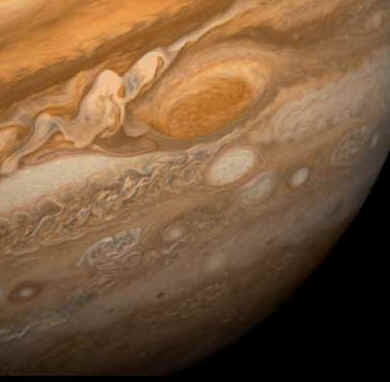
Once reaching the surface, the
muted light and heat produced is the diffused through the translucent surface and
appears to an observer as the "Great Red Spot". The color due to the
iron oxide released from the core getting caught in the updraft. The area’s higher temperature
causes a low-pressure atmospheric area to form above the surface. The density
differences between the atmosphere and the Red Spot form a cyclonic flow within
the effected area, similar to our storms, as the air masses try to find
temperature equilibrium. Only subtle differences in the internal currents of the
planet cause varying longitude positional changes, which would be represented by
a line perpendicular to the equator that terminates at either pole, over time.
This caused from a mixture of planetary matter in the moving bands, which are
not homogenous. Resulting in a slight variance in the planetary longitudinal location
the Red Spot. One only has to look at Jupiter’s net energy output where the
planet should be absorbing due to its distance from the Sun instead projecting
heat back into interstellar space to question
present theories. Mankind’s’ observation of the oval Red Spot, is one of many
surface anomalies, but the most astute and has failed to realize, that
Jupiter’s red glow emanating from the spot, is an internal phenomena produced
from within its core.
Jupiter's Bands
If one needed an observation to confirm that
planetary rotation is derived from a liquid spinning core, Jupiter is your
answer. Currently physicists assumed rotational torque was conserved as the
object cooled and its radius about the axis of spin was reduced and this
increased rotation continues today. An examination of Jupiter's semi fluid
surface shows bands of surface material moving at different velocities to each
other. Mankind's rule of conservation of angular momentum states the mass as a
whole increases the rate of spin as the radius shrinks. So why are there surface
variations contained within established bands parallel to equatorial rotational plane?
The core in motion as a result of finding
equilibrium as the attracted area overshoots until attracted again thus
reinforcing rotational spin. It is the transfer of energy through the frictional
contact of the core to the mantle and its efficiency is a function of the angle
formed by the equatorial plane and its intersection with the axis and an
imaginary line that passes through the contact point at the mantle of the
planetary object. Since Jupiter's mantle and surface is semi fluid the surface
mass breaks into bands due to velocity differentials as the angle increases
towards 90 degrees instead of a somewhat constant speed observed on Earth due to
a harden crust. Break points develop as a result of where it is easier to
slide pass each as oppose to moving as one, which is achieved on terrestrial
planets.
This is the source of the
parallel series of wide bands semi-fluid mass flowing at different rates on the
surface of gas planets due to the average mass of the material flowing in the
parallel bands and it’s distance from to center of rotational axis. A
differential in surface flow rates is confirmed by your telescopic observations.
All Rights Reserved: © 2000, 2009, 2011
Mankind's
Current Theory on Jupiter's Red Spot