A Visualization of 12th Planet's Approach without its Moon Complex

Planetary Dynamics of the 12th Planet
AKA Planet X or Niribu
|
We will examine the many features of the 12th Planet Creation and Features The Process of Maintaining Life Culture Ancient Astronauts Gold Orbital Path Its Passage |
Basic Print Link
|
|
|
Presently the world is in debate concerning the unusual weather patterns, global warming and icecaps melting on Earth, presently happening at an unprecedented rate. Speculation and theories are now running rampant, but consensus points to global warming, but with the future of mankind on the line why has the US ignore world views? The true cause is unknown to most of the world's scientists, but those in the know have been promised safety for their silence. Can the common man prove otherwise, no. Information to an Earth changing event would be of the highest secrecy. If it comes they are prepared, you are not. If it doesn't life continues with its inequalities maintained. What signs would occur if an event was known to occur soon and little record keeping would left for checks and balances? Wholesale looting of the banking systems, consumer accounts and ignorance of Earth changes. Acquisition of natural resources would be of prime importance at any cost. Sadly all of these events have occurred, for those in the know of a timely event, many hedged their actions assuming they will never be confronted for the atrocities. Individual men made these decisions out greed and self, not governments. The primary problem is the longer the timeline to passage the greater the chance of exposure, so the games play on. Is it fair, no. But neither is life. What is done has past, move on, you can not alter. Can you change the laws where the common man is treated more fairly, there is hope there. This action is in your hands with the power of the vote and accountability for both sides of power.
Presently the object appears here, there and doubt sets in as denial is high. This interloper that has arrived into our inner solar system and is presenting a new threat. We will examine planetary dynamics of this 12th planet, its orbital path, and the resultant effects on a global scale during its passage of Earth.
Creation and Planetary Natural Features
To begin, we will discuss some of the features of the 12th planet, which are unfamiliar to our science, confirmed life on another world. The 12th planet defies natural planetary form of the solar system by coalescing as a rocky planet with a diameter of that related to our gas planets. The 12th planet, approximately 29,000 miles across is similar in size to our planet Uranus. The similarities between the two planets end there.
Present day cosmology has planets similar in size to our Jovian type planets, evolving only as gas giants and this is false. The planet, which could have been a stellar seed was caught slightly off the mid point between 2 stellar gravitational sources and thus develop an orbit rare within the galaxy. Contemplating the origin of the 12th planet, we must examine the creation event in of this part of the universe, the Milky Way galactic sector.
Billions of years ago, this area of the universe was under extreme compression due to a Black Hole, which captured most available matter within the former galactic area. The gravitational force increased to a point where compression of movement was affected on the subatomic particle level, which lock down areas at the galactic core, source of the black hole. With nowhere to expand, this energy provided the trigger initiating an event that tipped the balance of gravity and repulsion within the mass, thus a core containment breach, reversing compression to expansion. The result is the Black Hole exploded, hence the localized Big Bang. Dispersal of matter clumped solidified and initiated rotation as the mass compressed, stellar systems developed and caught in between the repulsion forces of adjacent systems rogues develop rarely.
In our area of the galactic expansion, two gravitational giants developed, but the availability of lighter elements favored 1 side and heavier elements the other. Added a secondary cosmic mass developed in the neutral zone sharing the heavy elements as well as the light elements a product of that rare developmental event. So lets examine what happen and the resultant orbital relationship between all 3 primary objects.
Our Sun attracted massive amounts of H-He elements around its primordial rocky core and proceeded to light due to gravitational compression as the mixture of heavy elements to light allowed the fusion process to proceed. The other gravitational anchor mass had a larger proportion of heavier elements within the core before the H-He elements were attracted. The compression for fusion was there, but the heavy element dampen the process, similar to the control rods in our present day reactors. The stellar sized object did not light, but had a similar gravitational mass to the Sun. Without the added solar heat in the local system, the heavy elements coalesce into small rocky masses, too small to attract the light elements the repulsion force was invoked between the matter, thus the unlit star harbors space trash. Matter that never assimilated enough mass to form major planets.
The core of dark stellar object is highly magnetic and fluid due to some sporadic fusion reactions where all energy and heat is quickly absorbed by the surrounding mass. The primary difference is its slow rotary motion as the core turns at a low rate of rotational torque due to the low viscosity of materials composing the core and the greater differential between the mass of driving core and that of the outer shell.
The rogue object clumped and expanded slightly off center of the 2 gravitational giants seeking equilibrium. As time passed, the mass of the 12th coalesced. In its molten state, still surrounded by the primordial hydrogen clouds interacted with the oxides trapped within iron emitted from the planetary surface due to heat. The highly magnetic core invoked electrical storms within the forming atmosphere that was captured. H-He an NH molecules attracted from deep space ignited with the released oxygen and water formed. Attracted by gravity it fell upon the surface and cooled the crust. As it pooled on the newly formed crust, the water accumulated into an ever increasing depression thus forcing up land masses due to equalization within the planetary sphere on the opposing side of the globe in relation to tectonic plate weaknesses and total mass of water pooled. Due to its general interstellar medium location between the gravitational anchors most of the available hydrogen gas was exhausted, resulting in planet being partially covered by water. The released nitrogen from the NH interstellar molecules and excess oxygen produced an atmosphere similar to Earth's with a slightly higher O2 content. For more details on planetary atmosphere and its creation consult planetary formation.
The newly formed cosmic mass settled into a gravitational niche where the forces of gravity and repulsion were some what balanced, but motion occurred as momentum from the Big Bang place the 12th off the equilibrium or dither point of the binary gravitational sources. This was an unusual event in the universe, as the12th planet settled in a gravitational neutral zone between the Sun, which proceeded to light and another stellar mass equal to the Sun, due to its internal structure, remained dark. With a this slight initial momentum, left over from the Big Bang, the 12th planet after thousands of Earth years was eventually moved towards one of the gravitational masters (the Sun or the Dark One) and its bi-stellar orbit was initiated. The odd orbit approaches slows from the repulsion force, stagnates then is ejected. The orbit slows and reverses details discussed under 12th path orbital path. Without the strong magnetic field, the 12th would be just another capture planet revolving in a elliptical orbit about a stellar size mass.
The 12th planet also has a ring system surrounding the planet similar to Saturn with an accompaniment of several captured moons. These series of rings, segmented by mass and density of the particulate, rotate about the equatorial plane, pushed by the angular momentum of the repulsion force emanating from within the planet. This process is covered in the paper planetary orbital plane and motion. The rings are composed assorted fragmented cosmic matter and dust partial composed of iron oxide, attracted by the planet’s strong magnetic field acquired through the many passages through the asteroid belt where the fragmented magnetic cores of objects that have collided were attracted. The position and formation of the rings are kept in place by a thin outward force emanating from the equator, the repulsion subatomic particle 2 flow and its high density return flow and eddies composed of gravity particles moving back into the center of the 12th planets’ mass. This action compresses the matter contained within spherical gravitational field into rings while moving about the dither point between both stellar objects, seen and unseen. The capture moons revolve about the planet similar to what is observed today, but when the planet is in motion, a new parameters affection motion of the dust cloud and moons change. Lets cover the changes that would be observe during a passage and movement through space.
When the planet is on the move, it's moons organize as stretched strings of connected objects vary and waft about shifting tubular containment field on the trailing side of 12th. Visually from a observation point on the 12th's surface, the moons would line up in a 3wobbly snakelike rows of cascading dim globes that dance and swirl about in a whirlwind formation as they are attracted and repulsed by the 12th planet and each other. They would shift rapidly in the background about a iridescent gold tinted red sky of perpetual daylight, similar to Earth’s early morning light according to the laws of repulsion and particle movement. Their separation is determined almost exclusively by their mass in conjunction with trying to find a balance between planetary gravitational attraction and the repulsion force emitted from the other captured moons and the interstellar particle containment field that restricts the oscillation of the mutual center point of the forces of gravity and repulsion.
Internal Heating and Lighting Systems
Planetary self heating has been known to exist in our universe and within our own solar system as this is process which occurs on Jupiter. What is unexpected in the phenomenon of continuous self-lighting and heating occurring on the 12th planet and present in many Brown Dwarfs is that the process can be shunted from natural occurrences where liquid water and life can evolve on the surface of the object. As this is not the norm in the universe where stars are primarily responsible for warming and lighting the surface of planets.
It is in the core of the 12th planet that the differences arise that inhibits molecular fusion. In our Sun, there is a smaller proportion heavy elements to hydrogen nuclei present in the core compared to the 12th planet. For those contemplating this new idea, one only has to look to the Sun’s magnetic field. It is the accumulation of iron in its core that is responsible for its powerful magnetic field. This allows the fusion process to proceed at a rate where the energy produced overwhelms the dissipation rate of the solar mass, consequential there is a build up of energy, resulting in matter that lights.
During the creation of the 12th planet deep within the interstellar medium there was a greater percentage of heavy elements coalescing instead of the H-He and NH molecules. So the planet assimilated hydrogen trapped just outside of the large iron-nickel core is under extreme compression as the mass above is not a light H-HE mixture, but more heavy elements. Now a planetary terrestrial object has sufficient compression to invoke the fusion process.
On the 12th planet, the fusion process is contained to a very small area just to the outside of the central iron-nickel core where the force of gravity provides sufficient compression of the hydrogen nuclei to fuse into other elements, primarily helium. The fusion process, dampened to a slow burn by a larger proportion of heavy elements, composed of iron-nickel to hydrogen nuclei, which is the source of its unusually strong magnetic field. Doesn't the process of adding or removing control rods of heavy elements in a nuclear reactor control the rate of reaction? Energy is released in a controlled or muted manner and transferred to the surface of the 12th planet. The energy originating from the 12th planets’ core is absorbed by the magma flowing near it. This moves the magma to an excited state; its lower density pushes the magma towards the surface where the energy is released below the crust.
The energy released is absorbed and released through the various layers in the planetary mantle. As the heat subatomic particle flow approaches the crust of the 12th planet the path of lease resistance takes precedence. The particle flow proceeding from the core from the fusion process excites the thin crust below the sea and builds, with no smooth transfer of energy to the next medium surface sea water, the sea floor strata, which covers over 85% of the planet's surface, the release of excess energy from constantly being saturated from below is a series ebbs and peaks as the matter returns from its excited state the energy is emitted in the form of phosphorescence light within the wavelength related to the red-yellow spectrum, but visually from deep areas the blue-green wavelength reflected naturally from seawater combines yielding an iridescent purple. A Chemical process, occurring deep within the ocean floors, produces a diffused light bounce back off the atmosphere surrounding the 12th planet. The land masses handle the transfer of energy from the mantle differently, absorption the low end infrared emission is more efficient and the solid under layers of crust easily transmits heat. The rate of heating of the crust is dependant upon the conductivity and thickness of the crust, which in most cases is warm to the touch on the 12th planet.
The internal heat produced by the 12th planet is a by-product of molecular activity set in motion by the muted fusion reaction occurring in the core. The liquid core of the 12th planet with a heavy concentration of iron, always trying to find a state of equilibrium, is constantly in motion. The magnetic and gravitational properties of the core, allows it to be attracted or repulsed to outside zones in the universe only to reach the target area and a new zone of attraction or repulsion takes over. It is the constant chasing of mass to find equilibrium within the core that causes rotational movement about its center, ultimately, drags the solid crust and is observed as surface rotation of the planet about its axis.
Planetary surface heat, a by-product of rapid movement of molecules within the 12th planet caused by a muted fusion process occurring to the outside of the heavy iron-nickel core and is the basis for the lubricating subatomic particle, heat. So lets define the process of heat and its relation from the source mass to the transfer of energy applied to the receiving mass.
When heat or specifically energy is added to a defined amount of matter, what occurs during this process on the subatomic level and how does the effected particle react to the process of moving from the excited state to sub atomic particle equilibrium. What subatomic particles are responsible for transferring energy from one mass to another, and how does the process of equilibrium of emitting heat subatomic particles into a closed system reverse the process.
The process of heat is where a specific set of subatomic particle absorb kinetic energy released from subatomic collisions. Once stored the vibration rate affects the atomic structure by spreading. (under revision)
The heat subatomic particles flowing under the crust, are absorbed into the landmasses and seafloors with the excess radiated about the planet's surface. Even though the land and water absorb heat at different rates, the constant flow of heat particles from the core of the 12th planet, results in the oceans and all land masses maintaining the same even temperature, due to equalization of the heat transfer rate of the sub-strata mantle over time. These temperature variances near the surface atmosphere are negligible, but there is a difference. The flow of wind currents on the 12th planet which are minimal and initiate for different conditions than on Earth.
On Earth, subatomic heat particles emanating from the Sun are carried to this planet via the solar wind and particle movement. These heat particles strike the surface of the Earth and are absorbed at varying intensities depending on Earth location or angle of contact with the direction flow subatomic particles emitted by the Sun. Once absorbed by the surface of this planet, heat is radiated at different rates from the land and water, creating localized air masses that flow and spin at different rates due to latitude and terrain across the surface of our planet Earth to compensate for pressure inequalities in the atmospheric pressures.
On the 12th planet, the even surface heating creates atmospheric drafts flowing in an up and down motion from a differential in heat subatomic particle transfer rates of the land as opposed to the water. The transfer rate of heat subatomic particles via exterior crust of the 12th planet warms the surface air at a higher efficiency. Creating a continuous cycle of onshore updrafts as low pressure forms opposed to the oceans forcing warm surface to rise and the air to cool in the upper atmosphere for precipitation to occur the force of the stored water has to tip the balance of the force of the updraft and rain falls. So breezes mainly occur only at the points where the air draft turns upwards or down draft intersection points of the surface.
Winds, normal here on Earth, blowing across the surface of the planet, are almost non-existent on the 12th planet. Though, as the 12th planet drifts into the inner solar system, solar heating from the Sun does occurs within the few weeks the planet is within close proximity stirring winds to crop to some extent upon the surface of the 12th planet. For a short passage little is done to affect the equilibrium of the planet, but over a few decades severe storms resembling the super hurricanes assault the 12th periodically.
Pyramids, Technology and Culture
Mankind has refused to accept the truth, when presented with the facts. Precision cut stones polished and level to 3/1000 of an inch on all sides of the block. Tools of bronze and iron did not have the hardness to cut granite or even hard limestone. Precise alignment with the north pole when all thought the world was flat. Stones that could not be lifted with present technology. What confuses the public during research is that some state carbon dating of the pyramids just 2500 years ago, but marine crustaceans embedded within the cracks below an old waterline present on the sides of the foundation of the pyramids are at least 12,000 years old. History states, "Archaeologists believe Egypt’s large pyramids are the work of the Old Kingdom society that rose to prominence in the Nile Valley after 3000 B.C. Historical analysis tells us that the Egyptians built the Giza Pyramids in a span of 85 years between 2589 and 2504 BC", reference: http://www.aeraweb.org/how_old.asp. The world population at that time was 20 million of which half were woman and more than half of the male population children. So what truly happened when the pyramids were built vs. fiction? Did the Egyptians build the pyramids, the answer is yes as slave laborers.
The pyramids (specs) that were built had a duel purpose, first amplification of subatomic particle flows unknown to man and its purpose not understood yet. Secondary as an observatory to time the exchange of personal and material acquired during a stay on Earth and its transfer to the 12th planet. This pyramid design was the basic structure of the 12th, first the best natural geometric building form to withstand the increased gravity on the 12th without collapsing under stress. The ability to refocus the heat to a designated area where living quarters could be in place. As the ambient race progressed technologically, certain amplified particle streams, which will be introduced in the yet to be released paper Cellular Regeneration and Accelerated Growth were exploited for their beneficial use on an organic molecular level.
When first exploratory colonies settled on Earth they built examples what they knew and functioned at home. The natives were taught written language, the simple principles of math, geometry, astronomy and basic smelting still the foundation of our society. All to assist and provide the visitors an educated source of manual labor pools without revealing technology that would elevate the subjugated to where they could rise to a threat. Mankind was enslaved with their own kind educated above the rest to maintain order, the past on traits of the elite. The first settlers arrived here 500,000 years ago, and were far more advanced than present version of mankind in the early 21st century.
During there stay over the many millennium, the pole shifts were mild until a major unexpected one occurred. The resultant flooding and sinking of many of their cities and more important mines with great loss of life, Earth was abandoned. Man once the former slaves after many years of turmoil migrated back to the cities of now what was consider legend. With word of mouth and almost all physical and written records lost, encampments built and empty buildings occupied. Not able to recreate, but a on a small scale copy, knowledge gain by those who oversaw the common man took their ability to scribe and recorded what was taught to them on scrolls and tablets. The main depository the library of Alexandria. This where the predecessors of western man examined and decoded the language to give birth to geometry, calculus, general knowledge of the stars, banking, government, and ruthless control of populations. All of this taken secretly under the cover of a fire in the library of Alexandria as no one will come after what was thought to be lost in a fire documents which held no advantage over another man. It is the principles of banking and its ultimate control on the people and their governments that was the key knowledge as the first to successfully recreate this knowledge, shall control worlds and this has been in the hands of a set of elite families for many generations. But, this is not the primary cause of the many problems that afflicts the world today as the few with knowledge acquire massive wealth and control over generations of family with one purpose, to siphon off a small percentage wealth from the people over generations. The problem is those who were taught have decided to take their share, the middleman who has observed and learned and wants to steal his share. This is what has caused the great loss of wealth from the common man and the accounts tied to the stock market and the chaos seen today undermining world banking, currencies and governments.
Technology of space flight was just the start. The ability to influence gravity help reduce the weight of stones that needed to be moved. Lasers allowed precise cutting techniques to achieve small tolerances on surface edges. To the crude natives (mankind) they seemed like gods with strength and speed augmented due to Earth's low gravity and so it is recorded in Earth Mythology as the pole shift disrupted life, they left and survivors passed down encounters by word of mouth, which became today's legends.
Its Influence on Earth's Civilizations due to Encounters with Ancient Astronauts
Earth and its population was enslaved over many millennium and this affected all cultures. From the Mayans and Aztecs which shared their pyramid technology observatories with Egypt and the Mediterranean established bases where many humans entered and few left, captured the imagination of many only in myth. All linked by a single culture with a single purpose to mine, extract and refine gold and ship it back to their home.
Advanced in crystal formation, molecular preservation, structural construction, manipulation of gravity, lasers, space travel, water and sewer systems the natives were taught on a need to know basis. Those chosen to serve within the few advanced cities mimic themselves after the lighter, fair hair population of what was to become Europe. Rule was absolute, the governors implemented supreme authority over the territories with the use of chosen humans to maintain order and fear among the workers. The gladiator games used to amused the visitors were the predecessors of the Greek Olympics and the Roman slaughters in the coliseum. The native wear on the 12th was and still is the toga. The abandon cities, knowledge passed down all had its roots in the former inhabitants. But the advancements in buildings were lost over time, Egypt reverted and enslaved the Jews, but the bricks were now mud and straw. Greece and Rome lost buildings to decay that were never replaced over time. Legends of lost cities will never come to light as they were sweep away under waves in that severe pole shift, its occurrence unexpected by even the 12th inhabitants residing on Earth, which forced there retreat to another location mining location within the solar system Mars.
Again the 12th planet inhabitants exploited another world destroying the ecological system of the planet as the water flowing on its surface is now gone and with it the oxygen atmosphere. Pyramids again were built there as high resolution photos taken by Voyager in 1976 of the Mars Cydonia area (as of Nov. 10, 2009 photos were still available of the web) reveal when compared to those of Egypt. What about the new photos proving the image was formed by shadows? The cameras available today would be able to identify objects a few feet across on Mars when spy satellites above Earth can read the print on newspaper from. Your first clue is the resolution of the photos released, second the shapes do not match the pictures or show the entire field of view. Look at the overall shadows produce from all surface objects on the planet, the features are not just random. For now, some in power, state you are not ready for this knowledge, but really a vast majority on Earth could not care less about the alien presence unless there is something in it for them and that is the truth. Presently mining in the area of Mars has moved to one the moons, this info provided by zetatalk.
Now lets dispel some of rumors associated to these mythical gods. First they were no different than man if they were allowed to continue there same pattern most of you on Earth would have faced a brutal life and all would be slaves of some sort. These ancient astronauts did not genetically engineer man, for he was here as a creation through the wisdom of God. It was only the ignorance and weakness of mankind that gave birth to the myth of the gods, these visitors were only another race within this solar system taking advantage of minerals and native populations for their own gain with the use of advanced technology. The deeds done here where criminal against the race of Man. This is no different than what Europe did the rest of the world during colonization, as they were taught well by the scrolls of history. With their advanced scientific knowledge and doctrine of not mixing with the locals except for sex slaves, many legends on Earth were spawned all with some element of truth.
The Origin of Gold Smelting and its Ultimate use
Gold was raised to a standard of wealth by mankind as this element that had a valuable use on another planet, the visitors acquired this through forced mining. When this planet was abandoned its value among the former human slaves was adapted and to this day is the base for world monetary systems.
Astronomers observing the 12th planet for the first time will notice a diffused fuzzy appearance, due to Two factors: First, the dispersion of the sunlight through the iron oxide nickel cloud of particulates, and second, the artificial reflection of heat and light subatomic particles from gold isotopes floating about in its atmosphere.
As technology improved on the 12th they were able to take advantage of the planet's strong magnetic field. There primary concern was to increase the availability of planetary light on the its surface. Next, retard the escape of heat into space when cloud cover was not available. The bonus minimizing the temperature differentials of the air masses circling the planet, thus moderating winds and storms. So how was this achieved?
The 12th planet's magnetic field produces a strong flow of electron related charged subatomic particles. There choice was to introduce into the upper atmospheric zones flakes of gold. Once a an extremely thin leaf of gold adapts this charge as subatomic particles leave the north pole and return primarily to the south pole and in some case points about the equator, it is polarized and can be attracted or repulsed. Gold does not tarnish and has a one of the highest elemental conductivity rates, thus when distributed at the edge of the atmospheric envelope, it was the efficiency of reflected light and heat balanced against gravity and the ability absorb the charged particle flow of the magnetic field surrounding the 12th, which determined the distance of the base layer of gold foil particulates.
Once charged, the gold foil repulses each other forcing the outer layers away the foundation layer, while gravity slowly erodes the orbital distance of the prime layer resulting in the entire mass moving back as a whole towards the planet. This was problem was overcome by placing in orbit below the primary layer gold foil, a network artificial satellites that projects a like magnetic charge directed to the foil pieces. Thus orbital stability is achieved by the repulsive force. Secondary, the gold isotopes with qualities of lower density and high reflectivity alter the appearance atmospheric properties of the 12th planet. After the artificial dispersion of the gold isotopes are injected into the upper atmosphere during stay at the dither point, they float in a dust like particulate form in what would be similar to our ionosphere. An artificially produced charge on the lower fringes, repel the isotopes towards space and gravity then attracts them back. This constant cycle of repulsion and attraction takes a toll on the field as those isotopes pushed to the edge where they are torn away and depletion sets in during movement through the solar systems. There is a constant need to replace the gold, hence the mining efforts throughout our solar system. The gold isotopes reflect and scatter heat and light back to the planet's surface, thus an ultimate form of energy conservation for this civilization. It is similar to how cloud cover retards heat loss on Earth from escaping into space.
During the orbital passage of our Sun, the solar wind rips away this artificial layer of gold flake reflective insulators during its stay within the inner solar system, thus a need for periodic large quantities of gold. With resources at the planetary level dwindling they looked at exploiting Earth. Planetary geologists realized after a ancient massive collision of one of the system moons and the proto Earth pressures directed at the where heavy elements pool, the core forced heavy elements towards the surface on the far side of impact, Africa and the mountain ranges forced up along what eventually was called the eastern Pacific. Mining expeditions traveled to Earth and with their advanced technology 500 thousand years ago exploited resources and the native population, man. Once the mining sites were abandon about 12 thousand years ago, man retained the knowledge of smelting location of ores and assigned a great value to a material that they were once force to mine as slaves.
The View on Another World
When one stands upon the surface of the 12th planet looking out from the pristine beach, the ocean would glow of Phosphorescence reds, yellows, oranges and purples as particle flow energizes the seafloor varies by intensity and depth. Soft onshore breezes are the only winds on the sub heated sands. Then as you gazes into the heavens, the beautiful vision of this off world planet would be something to behold, the sky shimmers with what seems like an infinite amount of subtle golden tinted red sparkles scattered about a faded red-pink pastel background. What is amazing is that the heavens are still visible against this backdrop as light is scattered throughout the sky as a soft dawn, with the absence of sunlight flooding the atmosphere. The dozen or so multiple moons reflect the soft red orange wavelengths illuminating there surfaces as they orbit above. The bonus comes as the periodic bursts solar wind hits the intense planetary magnetic field and auroras dance about the outer atmosphere of the entire globe for an experience beyond words. The sight leaves you breathless.
The Dynamics of the Orbital Path
An examination of the 12th planet's orbit not only yields a period of 3,657 years, but a new form of sling orbit, which traverses between both binary stars. One of the gravitational foci, our Sun has a set of planets revolving around it. The other foci, the Dark One, is a unlit mass equal to that of our star is orbited by space trash, details covered previously and is similar to the debris orbiting in our asteroid belt. This star failed to light shortly after the localized big bang in this sector of the universe due the internal processes related to fusion.
The
Dark One, a cosmic object of similar size and mass to the Sun, is located 11
degrees below the orbital plane of our solar system. It is approximately 68.81
billion miles away in the direction of the Orion constellation, measurements
courtesy of zetatalk.
During the 12th
planet's passage through our solar system, many variables come into play the
repulsion, magnetic and gravitational forces flowing towards the Sun and
ecliptic plane. Secondary how its passage affects all planets
differently according to their mass, proximity and orbital position when it comes through. Some
planets like the gas giants, being of equal or larger mass has faired well due
to the repulsion force, which keeps the two masses from colliding. Other smaller
planets and moons have not done so well, now only appearing as asteroid remnants
and comets that move
about in the belt between Mars and Jupiter and the odd orbits about the Sun in
deep space depending upon the resultant angles and momentum after collision. What is
different about the orbital path of the 12th is its varied motion of little movement near the
dither point between both gravitational anchors to rapid acceleration towards the
Sun. Altering its path from due to particle crowding and magnetic attraction of
the Sun, a slowing
inbound approach, leading to a stall about the ecliptic plane to a final ejection burst from the solar system due to the repulsion
force. Once outbound it slows and slings back towards the Sun. Motion on the far
side near the Dark One again is quickly captured as its magnetic field is more
organized with a greater iron-nickel core. The difference is no opposing masses
of great size impeding passage through the orbital plane. So ejection and
passage pass the Dark One is swift and consistent unlike passage through our
system. Currently, all aspects pertaining to
this sling orbit is not in any book.
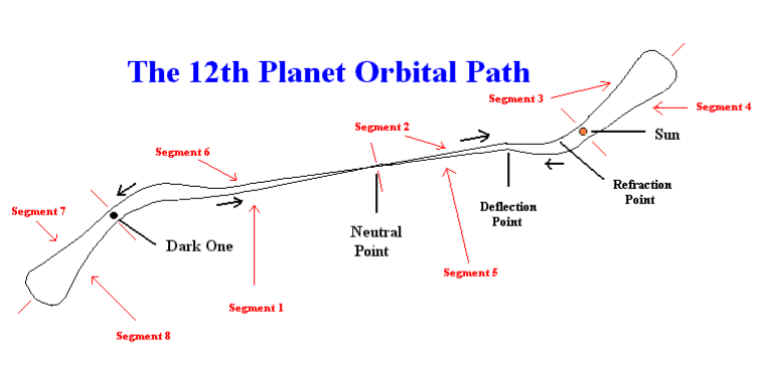
Diagram 1
In this diagram the usual orbital path of the 12th planet is shown to be a figure 8 and controlled by the forces of gravity and repulsion with original momentum providing velocity at the dither points. This sling orbit is counter to all know orbital principles of established astrophysics.
| Deflection Point: | is located away from the Sun about 2.5 times the distance from the Sun to Pluto |
| Refraction Point: | is located 880 million miles away from the Sun at the Ecliptic about the distance from the Sun to Saturn a point where the magnetic attraction of the Sun and the 12th super cedes particle crowding |
To visualize a clear picture of the 12th planet's narrow figure 8 orbital trajectory around both suns, the path has to be broken down into 8 segments. Four of these segments are a reflection of the other four except for the interaction of the 12th planet with the orbital plane of both systems where has planetary objects that could impede release and the respective gravitational-magnetic anchors. The arrival and returning path, if superimposed upon each other, would represent somewhat of a mirror image. It is just the direction of the 12th planet towards either of both gravitational foci that determines the difference.
Examining first half of the 12th planet's orbital path, which is composed of approximately 1,828.5 years depending on severity, we will look at the arrival path towards our Sun, in the first 4 segments of the planetary sling orbit. Our starting point will begin with a location, which is at the furthest distance from the far side of the Dark One, the intersection of segment 7 & 8. The journey starts with an approximate 4-year trek of the 12th planet being attracted away from the furthest point on Dark One's far side due to the combined gravitational attraction forces of both binary stars. With forward motion preserved as it pierces an imaginary line linking the 2 stellar objects at a maximum distance, the orbit turns it accelerates exponentially towards the unlit star from a counter clockwise direction.
If this is a binary stellar system then why is there no evidence of rotation about each other? Scientists have the evidence, but they have looked in the wrong place rotation about the orbital plane failing to connect the dots. The repulsion force emanating from the galactic center, the rotating black hole pushes the spiral arms of the Milky Way galaxy within its orbital plane. Rotation of our binary system settled and orbits about a central point at a point of equilibrium approximately 90 degrees away from the force pushing galactic stellar objects as the return flow along the galactic plane at our system's location is minimal. Its period of 52 thousand years is where one of the gravitational anchors spends 26 thousand years below the galactic plane and 26 thousand above. The galactic subatomic particle flow changes from the status of a ground to observable new emissions leading to many scientific wonders. With it responsibility towards others, the pole shift is here to make sure only those capable of that responsibility are around to use it. This is a choice, an individual human choice. Remember you cannot lie about your self orientation to God. Do you let a child play with guns, drive a car or take care of the house bills and income? Your governments know the Human race is an emerging species, but not one has evolved to the point to where they would be respected to make decisions affecting all in the galactic community.
The 12th planet during its travels through the system of the Dark One only encounters occasional space junk in its path. It veers down and away then up and in a smooth, shallow parabolic orbital path due to the repulsion force. The velocity of the wandering planet reaches a maximum at a point similar to the distance, but inside of the orbit of Saturn to the Dark One, due to no planets crowding the field like in our system. The repulsion force increases as penetration of the orbital plane invokes a slowing of the movement of the 12th planet towards the Dark One. Due to the increased magnetic attraction the 12th turns towards the Dark One sooner, overcoming the particle field causing deflection. The adjustment of angle of penetration is less than the 32 degrees of our system.
As the 12th planet approaches with in close proximity of the Dark One, the repulsion force primarily emitted in spurts along the equatorial plane of the Dark One slows the orbital velocity sporadically, because of a slower rotation as the core has a greater concentration of heavy elements the streams have larger gaps. As the 12th planet rises above the ecliptic of the dark one its south pole is attracted to the unlit mass's north pole. Thus first drawn up above the orbital plane and in as magnetic attraction over rides the repulsion force emanating from the unlit mass. Particle movement from the return flow of the orbital plane moving towards the unlit stellar mass as gravitational field compression increases as a function of distance closed and drives the 12th planet back towards the ecliptic plane. The resultant moves the planet back into a zone of magnetic neutrality. The repulsion force which has built up like a compressed spring releases in the absence of the magnetic attraction that was once there. Ejection the 12th planet occurs outwards towards the gravitational dither point between the two masses.
As the 12th planet drifts towards a mid-point between the Sun and the Dark One its velocity slows due the gravitational flow back towards the dark one, The planet settles and drifts slowly between segment 1 and segment 2 a period lasting approximately 1,820 years begins. The gravitational forces controlling the movement of the 12th planet between segments 1 & 2 has changed. The gravitational pull to the rear from the Dark One continuously slows the forward momentum and subtle attraction from the Sun come into balance, causing the 12th planet's orbital speed within a few years to be reduced to a point where apply force on the 12th is neutral or balanced. Essentially, it then hovers and Drifts ever so slowly covering a distance of 70 million miles or .019 S-P units in 1,812 years and crosses over a bisecting line between both stellar masses, while being caught in a gravitational tug of war at the mid point between the binary objects. At this virtual gravitational null point in the middle between segments 1 & 2, the 12th planet resumes its original planetary form of revolving moons and the dust cloud reverts to a ring system. It is only its original momentum conserved from when this orbital relationship started that pushes the 12th out over the neutral where the Sun's gravity starts to pull, thus increasing its velocity towards our solar system.
The 12th planet once on the move in segment 2 from the gravitational attraction of our Sun, covers 99.9% or 34.3709 billion miles of the distance from the neutral zone to the inner solar system, which is 9.362 times the distance between the Sun and Pluto or 34.405 billion miles between the two stars in a time period of 215 weeks or 4.14 years.
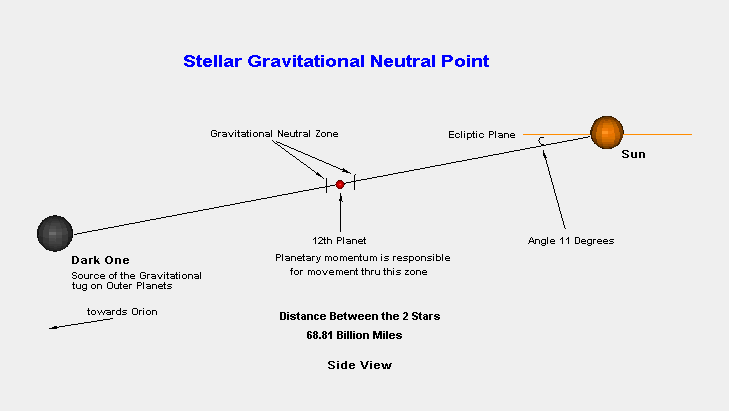
The Gravitational Neutral Point Represents the Area between Segments 1 & 2
 |
|
Diagram 2 The neutral zone is where the force from opposing gravitational fields negate each other, therefore the dominating force affecting the planet is its original momentum inherited from the localized big bang in this Milky Way galactic sector of the universe. This conflict within the zone takes approximately 1812 years to resolve itself per transit between the stars. |
During the 4 years as the 12th planet moves from a relative static state and momentum tips movement towards the Sun due to its gravitational attraction with an initial velocity of Constant B (momentum inherited from the big bang). The 12th planet then drifts out of the neutral zone into an organized gravitational subatomic particle flow returning to our Sun's core. Its velocity increases exponentially, thus forging a path straight and true towards the Sun approaching a velocity that is a fractional speed of light. This explanation is no different than Newton’s gravitational law stating, once an object is released from above the Earth, does it not accelerate at an exponential rate, 9.8 meters per sec./ per sec. towards the surface. In the environment of space, there isn’t any friction. Therefore, acceleration of an object large enough to pierce through the solar wind and avoid the subatomic particle movement expelled from the Sun’s equator will rewrite all laws of orbital mechanics. Scientists will have no explanation for the rapid approach of the 12th planet which occurred during the first half of the decade 2000 - 2010.
On approach the 12th planet shifts laterally to the left in the outer regions beyond the solar system during encounters with the repulsion field streams that moves the other planets due to rotational torque inherited from the Sun. The 12th planet once caught in this repulsion field is pushed in the same counterclockwise direction looking outward from the Sun as the other planets as they rotate around it. This force increases as a function of distance and density towards the Sun, until reaching the repulsion deflection point, which is located away from the Sun about 2.5 times the distance from the Sun to Pluto. The point where the density of organized gravitational flows control all objects in orbit around the Sun is pushing back.
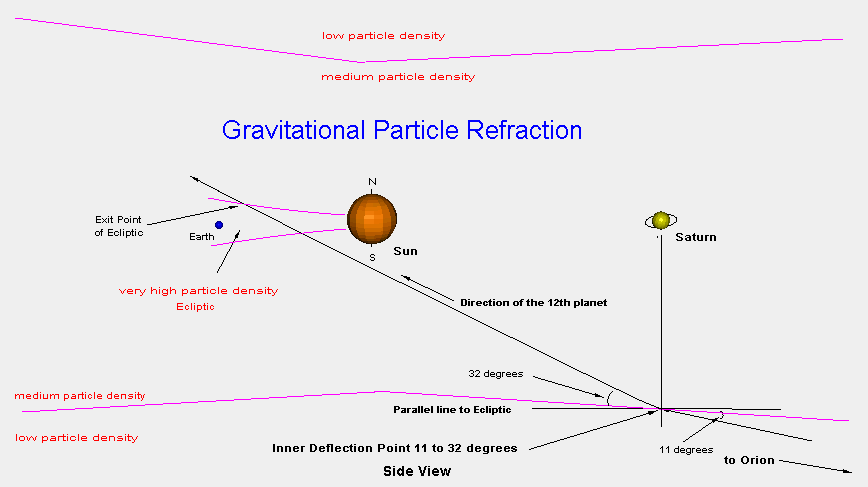
The deflection point is a new concept in astrophysics so lets examine what happens and how the various subatomic particle flows interact and their relationship with the interstellar medium. Our Sun emits repulsion particles, which allow mass to have an orbital relationship with our Sun. The return flow gravity particles and the pressure from the interstellar medium dark matter sets a point of containment where inside particle pressures maintain order outside of it mass falls freely towards the Sun. The containment field is what limits the outer edges of the Kuiper Belt (Illustration). This is where primary repulsion flows slows to static position just inside the containment envelope and the flow either bleeds off into the interstellar medium or organizes and flows back towards the Sun.
The 12th planet when encountering this containment field deflects around by approaching under the field taking the path of least resistance outward and south away from the upward line of approach towards the Sun. This continues until the gravitational and magnetic forces of the Sun overwhelms the lateral factors of velocity and repulsion away from a direct line of approach and the orbit bends back inward towards the Sun in a smooth shallow parabolic curve extending from a point below Saturn’s orbital path.
The 12th planet alters its orbit for a path of less resistance, shifting its angle of attack through the plane by 21 degrees for a total of 32 degrees. This adjustment in the angle the 12th planet allows the piercing the orbital plane; it is a compromise between forward momentum maintained by gravitational and magnetic attraction and the opposing repulsion force slowing its forward momentum. The force of repulsion applied against the forward momentum of the planet significantly decreases the orbital velocity in the inner solar system. Passage through the orbital plane are determine by set of random factors, orbital placement of the planets which would push back due to the repulsion force, thus determining severity of the pole shift.
As the 12th planet approaches from below the ecliptic plane momentum added with the return flow of the high density repulsion particle which maintains the orbital plane, forces it up towards the ecliptic and an overshoot occurs. In this particular passage complications occur and Venus and Earth blocked a smooth exit as the repulsion forces from both planets were pushed into the 12th planet's path during the early stages of piercing the ecliptic plane. At first the 12th planet encounters a spurt of repulsion subatomic particles sweeping outward from the Sun along the orbital plane. The 12th is moved in spurts propelled every 6.5 weeks by the repulsion force as it exits the backside of each of the 8 streams that emanate from the Sun. Its slight clockwise orbit which passes the Sun is pushed in a counter clockwise rotation similar the planets during contact until passing through the field. Once out of the repulsion field stream, the force pushing back 12th planet snaps back quickly due the stored potential energy to its original path through the solar system due to the Sun's gravitational and magnetic attraction.
The largely diminished velocity of the 12th planet stuns scientists holding on to established theories (orbital velocity in an elliptical path increases as it nears the Sun), no viable explanation will be presented. New events are initiated by the gravitational and magnetic forces of the Sun and a magnetic link between the 12th planet’s north pole and the south pole of the Earth leads to erratic behavior of the Sun and Moon.
Normally the force needed to invoke planetary ejection from the inner solar is overcoming the high density return flow and its gravitational force directed from above the orbital plane towards the ecliptic. The 12th begins an oscillation pattern back towards the ecliptic and its north pole turns toward and realigns with the Sun' magnetic field releasing this attraction as the poles of the 12th and the Sun line up side by side. The repulsion force built up from magnetic compression releases and the 12th is forced towards the Earth-Venus. The push back starts to close the distance between the 2 planets and motion to the rear is impeded by the continuous repulsion stream emitted from the Sun which drives planetary orbits. This interaction of planetary blockage, which pushes back with repulsion force. This increases gravitational subatomic particle density along the ecliptic plane and forces the 12th to pop above the ecliptic seeking equilibrium, as a result the planetary poles of the 12th turn as field force particle stream polarity increases as a function of distance above the ecliptic related to the north pole and the magnetic attraction of its south pole to the north pole of the Sun occurs again. The magnetic attraction draws the planet closer and the repulsion force builds as potential energy. The 12th encounters a greater force at the same relative elevation of the ecliptic back towards it, the return flow gravitational field density increases as a factor of moving closer, forcing the 12th down into magnetic neutral zone where it is released and catapulted forward. The situation dithers back and forth over time and this is why Earth's best scientists will never be able to predict the point or time of passage.
Knowing Earth is being rocked back and forth over an extended period of time, when the break occurs, the event will not be passive, contrary to what you are being told by the establishment. During this period of dithering oscillation, much of the compression of the Pacific and expansion of the Atlantic would have occurred. The electrical grids will be non functional due to the constant magnetic surges as the 2 planetary fields couple intermittently and on a planetary level, the insects sensitive to these particle flows and raised energy levels will be forced to the surface. For those exposed to the elements, the constant gnawing, pinching and bites from insects pushed from the depths will be hell on Earth. The change for orbital ejection will be put into final motion when the 12th rises high enough within the orbital plane with the Earth magnetically locked as its pole turns.
The Earth and the 12th close distance the release outwards from the Sun pops the 12th well above the ecliptic and the north pole is repulsed severely. The 12th overshoots the equilibrium point where the north pole flips in a south to north alignment with the sun and rotates an additional 90 degrees towards the north pole. The rotation reverses in a dampening oscillation as the 12th with its magnetic poles inverted, thus the first of the 270 degree rolls for the 12th planet. During this oscillation the 12th is drawn towards the Sun every time the south pole points towards its north pole.
The drama happening on the Earth is beyond unreal as the 12th points its north pole towards Earth and it too rolls 270 degrees oscillating wildly until the pole settle in and points its south pole towards the Sun locks for several days. The unusual sight is watching the Sun set then rise then set then rise just above the horizon and finally set, a result of oscillation. Simultaneously drawn closer to the Sun a clash of magnetic fields occurs as the Earth moves into the shadow of the 12th for 3 days of darkness and the magnetic fields align inverted to the Sun. The Earth moves out of the shadow as the 12th is pushed towards the ecliptic plane by the increased gravitational force as the distance between the 12th an Sun closes. The stunned inhabitants of Earth now experience sunrise on the western horizon.
As the 12th is forced back towards the ecliptic a great potential of repulsive forced is stored due to the magnetic attraction is neutralized. The 12th flips to the Sun's alignment and earth follows suit some 6 days later. Once released 12th assaults the Earth and is repulsed upwards and back into the upper ecliptic plane. The 12th immediately performs another 270 degree roll as is quickly pulled towards the Sun. The Earth wobbles wildly for a short time while the 12th now closer to the Sun is forced to the ecliptic due to intense gravitational flows. The alignment matches the Sun and the 12th is ejected out of the solar system.
During this phase, intermittent meteor showers of varying sizes from dust, to mostly pebble size and the occasional car sized bolder assaults the Earth months prior to passage, with an all out barrage approximately 1 day prior to Earth passage, not seen since the last passage during the Jewish Exodus. These small meteors and dust trailing on the fringes of the 12th planet's trailing gravitational field are pointed towards the Earth due to the coupling of the magnetic fields and gravitational flow. This large field of space debris and small meteorites mostly composed of iron oxide with its forward momentum intact, assaults the Earth. Propelling this large field of debris many millions of miles wide, at a high rate of speed towards Earth, initially arrives as a fine layer of dust, which turns the water and land red from iron oxide on the dayside of Earth in isolated local instances initially and spotty occurrences on the night side as magnetic surges redirect established particle flows. The assault from the 12th spreads about the globe.
The Earth is drawn in closer and has little time to react as the force of 12th approaches quickly and points its north pole towards Earth as it rises through the ecliptic. Now due to close proximity of the 2 planets, they magnetically lock and rotation of the Earth slows until seizure. This frictional core contact with a magnetically held stationary crust stretches and drags the western side of the Atlantic Rift widening the Atlantic Ocean with new magma gushing from the rift as a new crust forms below the ocean. The new crust and core rotation pushes the existing surface of the Earth (Eurasian plate) to be the eastern side of the Pacific. With nowhere to go the crust is sub ducted under the North and South American plates and mountain building and hot Earth occurs. The volcanoes along the Pacific Rim explode with others around the world. The result is a shortening of the Pacific Ocean. The final passage is the last major step preceding the many small steps of expansion and compression when the rift was held or tugged.
As the 12th planet approaches within 14 million miles the South Pole is attracted to the 12th planet’s North Pole and again the meteors and dust fully assault the planet coating everything red just hours ahead of the shift. The crust totally separates from the core, due to the magnetic force streaming from its north pole and rotates away from moving 12th planet causing the shift to pop and additionally dragged after dampening oscillation the settles approximately 120 degrees from the initial position. During the passage, the 12th passes quickly and the shift is over in a hour, rotation returns several days later slowly at first, but the 24 hour day does return. The 12th planet effects can be minimal to catastrophic on the planet Earth, dependant upon the ejection velocity and proximity when its magnetic field is realigned. Although, consensus regarding this pole shift will be catastrophic, but there is hope, because most death will be to depression, which is in the hands of man.
 |
|
Diagram 3 Reverse Image As an object moves a low to a higher density even though it is in the confines of outer space where mankind only sees a vacuum or the interstellar medium dark matter, an object is subject to deflection particle crowding due to the repulsion force emitted from the Sun the 12th adjusts for the easiest path outward and to the south of the Sun. |
|
|
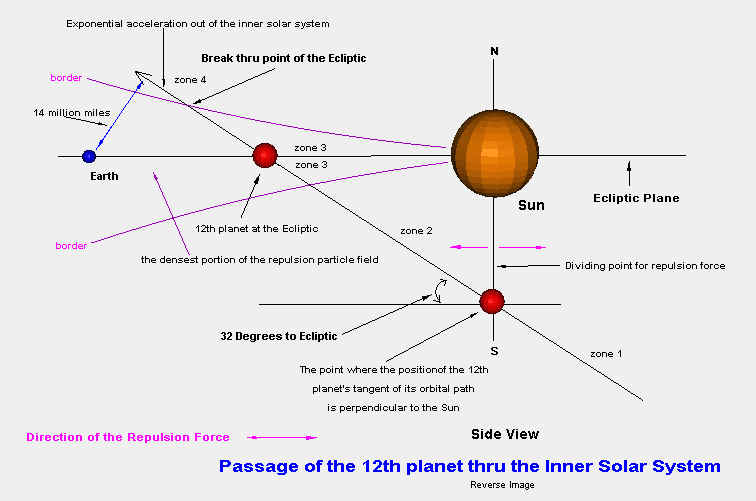
Diagram 4 The Inner Solar System and Ecliptic Plane |
| Zone 1: As the 12th planet passes thru zone 1 the repulsion force in combination with particles exiting and entering the Sun in the Ecliptic zone dramatically slows the incoming planetary velocity from a near fractional of light speed to where only inherent momentum carries it pass the Sun. |
| Zone 2: In this zone, the momentum of the 12th planet radically changes as it enters the inner solar system, slowing as a result from outgoing particle flows from the Sun and the increasing density of the repulsion force and its affects on the planetary mass. Exposure to this force reduces the forward momentum of the 12th planet to a crawl through the inner solar system. The process of movement transfers from the 12th planet's incoming velocity to conservation of momentum. |
| Zone 3: It is here the 12th planet encounters its greatest resistance to forward motion, the orbital plane. It is here that the repulsion force emanating from the Sun provides the greater percentage of push vs. latent momentum conserved from orbital motion to pierce the Ecliptic. This is the zone where the 12th planet will linger for years depending upon particle flows to and from the Sun. This oscillation above and below the ecliptic must play out. The difference in this passage is the position of Venus and Earth, which stalls. The reflective bounce back between the planets of Earth, Venus, the Earth twin, the Sun and the variable, the 12th planet is this process that must evolve. Over the passing years the 12th reaches a point where the Sun's magnetic and gravitational field effect the motion of the 12th just before the passage of Earth's shift and the ejection from the solar system. |
| Zone 4: The repulsion force pushing the 12th planet encounters a drop encountering incoming gravitational particle field density as it moves out of the crowded field of the Ecliptic plane. Now the 12th planet is catapulted out of the inner solar system as the balance of forces now favors the repulsion force. Like a spring when the tension is released the increase in velocity is a decreasing exponential after peak velocity. |
As the 12th planet punches out of the Ecliptic plane at 32 degrees from the return high density gravitational flow moving towards the Sun, the third segment has already begun. The 12th when magnetically pulled towards the Sun north pole stores a vast amount of potential energy in the repulsion force due to the physical inward displacement of the planet from pole attraction. Once the return flow from the high density gravitational flow returning to the Sun forces the into the magnetic neutral zone a force differential occurs, (this the basis for interstellar travel) with the holding power of magnetic attraction removed and only the force applied to the planet provided by the Sun's gravitational flow an imbalance takes places a the stored potential of the repulsion force is converted to kinetic energy and the planet accelerates into the return flow deflects and fans out at 32 degree angle above the orbital plane. The Earth response to the passage tilts to align. As the 12th moves on the Earth starts to realign with the Sun, but rotation returns within days and settles at a 23 degree tilt and the poles wander to adjust to the Sun's magnetic field. The wandering planetary system, the 12th planet, composed of its many moons, meteors, space trash and dust trailing behind in its gravitational wake like a string of pearls that not only oscillates above and below a center line of movement, but maintains a circular pattern of evasion by shifting laterally when confronted by blockage, passes quickly during its travels through the solar system. As the 12th planet continues on its orbital path out of the inner solar system, new forces effecting its movement come into play.
In segment 3, which has a approximate time period of about 4 years, the orbital path of the 12th planet takes on a different track by answering to both gravitational sources. The repulsion forces flowing from planets coupled with the counter clockwise angular rotation of the repulsion particles emanating from the Sun, that maintains the orbital velocity of the planets in the solar system, pushes the 12th planet's orbit outwards up and away from the central axis of the solar system increasing its velocity. The momentum decreases after passing outside of the Kuiper Belt, a point where the repulsion force and gravity maintain rotational gravitational order about our Sun. Once outside of the influence of particle crowding the 12th immediately tries to move back to the equilibrium, the 11 degree gravitational plane differential between our solar system and both gravitational masses. Since both gravitational sources are now to its rear velocity slows quickly and the orbit take a parabolic path turning clockwise towards the center between the gravitational masses.
As forward momentum away from the Sun slowly comes to a halt, conserved momentum shifts the direction of movement for the 12th planet to laterally across space to where this momentum carries it past the center line of the 2 gravitational sources. Finally the 12th planet encounters, what is the furthest point from the backside of the Sun. Orbital segment 3 has ended (reference diagram 1) and segment 4 starts, which mirrors 3 and lasts for a period of 4 years.
The path of the orbit has now accelerated back towards the Sun due to the combined gravitational flow of both objects and its resulted velocity towards the centerline and Sun increases exponentially. Yielding an orbital path on the back end that takes on the shape similar to a slightly flattened ice cream cone. As the 12th planet finishes its orbital path around the backside of the Sun, it arrives once again in the inner solar system, deflecting at the Kuiper Belt and then altering it path to 32 degrees again while passing through the orbital plane.
Returning to the solar system some 8 years later, after the 12th planet has had its final encounter with the Earth, dynamics of the passage and interaction has changed. As the 12th planet passes the Sun, between segments 4 & 5 the orbit slows almost to a halt due to the repulsion force again, but its stay is determined by the position of the inner planets that could block its forward progress. None are present to impede progress. Though the affects the Earth experiences in comparison to the initial passage are muted, conditions the Earth faces are different this time, due to several reasons. The turmoil and magnetic interference in the core of the Earth caused by the 12th planet are always present, as the wanderer moves around the backside of the Sun. On this passage, the second encounter, the crust of the Earth does not realign. The 12th planet passes no closer to Earth than 100 million miles, compared to 14 million on the first passage. The second passage of the 12th planet to the surprise of many will be only a minor disruption in the flow of life. High tides, tremors and extremes in weather patterns and the 12th will eject out of the inner solar system without dithering too much about the ecliptic plane. After two 270 degree rolls and it is propelled out of the solar system cleanly.
In segment 5, the movement of the 12th planet between the Sun and the Dark One is the same as segment 2, but reversed. The 12th planet momentum accelerates due to the repulsion force and exits the solar system swiftly. Once outside of Saturn’s orbital path gravity now becomes the dominant force and momentum slows due to the Sun's gravity against the Dark One's attractive force for 4 years. Velocity almost comes to a halt between both gravitational anchors, and the 12th drifts slowly due to inherent momentum conserved from the dawn of the solar system near the midpoint for approximately 1,812 years.
Once
completing its stay at gravitational midpoint between segments 5 & 6 and the
12th crosses a point where organized particle flow proceeds towards
the Dark One and the 12th planet speed increases exponentially towards the Dark
One in a time period of approximately 4 years. The 12th evading the
particle field of the Dark One moves to the outside and turns at a sharper angle
less to the repulsion force from orbital matter and a its stronger magnetic
field. It is here, between segments 6 & 7 where the 12th planet has
slowed enough, that the trailing gravitational wake holding the tail together
gathers stray meteors, dust, and assorted other space trash, when passing
through the debris fields revolving around the Dark One. Replenishing material
lost during its orbital encounters with our Sun and Earth. This process
continues until the carrying capacity of the tail is maximized. Inside this
system the planet rolls once and is ejected as the particles within the orbital
plane are compressed due to lower ambient temperatures and a stronger magnetic
field. After the 12th planet has left the vicinity of the Dark One. As the 12th planet
accelerates accelerates from the Dark One, segment 7 follows the same pattern as
segment 3. The combined gravitational forces of the Dark One and
the Sun slow forward momentum and turn the 12th planet clockwise.
Once the 12th planet reaches the furthest point of the sling orbit on
the far side of the Dark One, the orbital velocity accelerates towards the dark
one and slows when passing the dead star and the orbit is complete, and we have
returned to the starting point, segment 1 where12th planet encounters the repulsion force
and drifts thru the Dark One's ecliptic plane.
 |
|
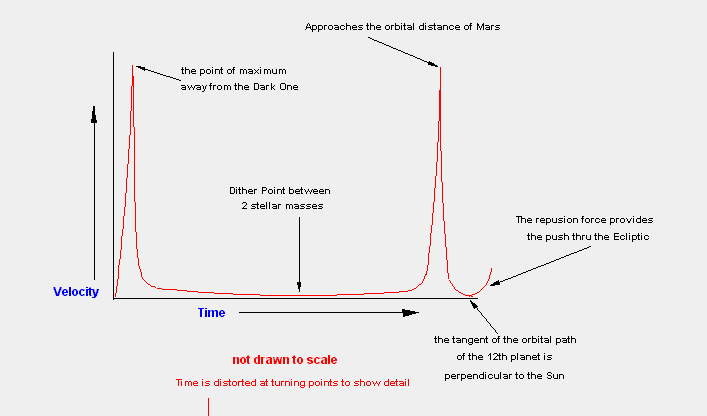
Diagram 5
A velocity vs. time graph detailing movement from the Dark One to expulsion from the inner solar system of the Sun. |
Visualizing a graphical representation of the 12th planet's movement, starting at the Dark One to the Sun where the Y-axis is velocity of the 12th planet and the X-axis is the passage of time, it would mimic 4 hyperbolic curves in the shape of a wide U. A rapid acceleration away from the dark one reversing to steeply decreasing hyperbolic curve represents a rapid loss in velocity as the 12th planet leaves the gravitational influence of the Dark One to its rear. As the Y value velocity approaches 0, the curve flattens until it is parallel to the X-axis. This area of the graph would represent the time spent and the velocity of the 12th planet at the mid point and stalled near the gravitational anchors. The curve stays its course essentially until the time value along the X-axis reaches approximately 4 years before Earth passage. The hyperbolic curve then rapidly ascends steeply, once the 12th planet is firmly in the gravitational grasp of the Sun. The Y value, velocity, increases exponentially until the 12th planet reaches the Sun’s repulsion force. The curve plateaus and progress through a steep exponential decline until reaching the Sun where the curve flattens to a constant or flat horizontal line. The slope of the curve at any value T (time) equals the rate of change in velocity or acceleration. The area under the curve between 2 time intervals is equal to distance traveled by the 12th planet. The boundaries for the Distance traveled is enclosed by the hyperbolic curve at the top, the X axis at the bottom and two perpendicular lines to the X axis which represents the initial and final values of time. It is the hyperbolic function that was used to derive the distance table
All Rights Reserved: © Copyright 2002, 2004, 2009
The Orbital Mechanics of the 12th Planet
Mankind's Version of the 12th Planet
Related Articles
The Origin of Comets and the Oort Cloud
Zeta Talk is provided by the courtesy of Nancy Lieder
the site: http://www.zetatalk.com